|
I've always been a bit surprised that the musical, Take Me Along, doesn't get performed more and has largely become lost. It has strong source material -- from Eugene O'Neill, no less, Ah, Wilderness!, the only comedy that O'Neill ever wrote. And a quite-wonderful score by Bob Merrill, who would go on to write the big hit Carnival! and then do the lyrics for Funny Girl with Jule Styne (teaming up again for the classic TV special, Mr. Magoo's Christmas Carol). The show, which opened in 1959, was a respectable hit, running for 448 performances and getting 10 Tony nominations, including Best Musical -- and winning for the Best Actor performance by Jackie Gleason. 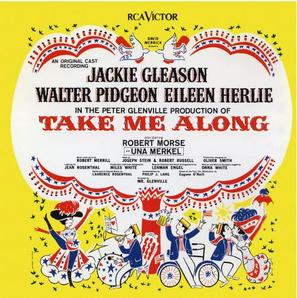 There are a few reasons I can think perhaps it's gotten overlooked. The show opened in the middle of Broadway's Golden Age, and good as it is, it got overwhelmed by other, better, far more successful shows of the same time. The same year it was nominated, for instance, other nominees included The Sound of Music and Gypsy, not to mention the Pulitzer Prize-winning Fiorello! The next two years brought Bye Bye Birdie, How to Succeed in Business without Really Trying and Carnival! The two previous years had The Music Man and West Side Story. It's easy to get lost in that company, not to mention all the others of that era. And then more years pass, and you're forgotten. It's also a bucolic play about a past, dated time, taking place in a pastoral 1910. So, that perhaps gives it a more dated sensibility. Though Hello, Dolly!, which came only five years later is set in the same era. (Historical sidenote: it has long been rumored that Bob Merrill, who wrote Take Me Along, came in as a "show doctor" for Hello, Dolly! and wrote two of its songs, "Elegance" and "The Motherhood March.") To a certain degree, the show's future reputation may not have been enhanced by the reputation that it succeeded to a good degree because of the show's star turn by Jackie Gleason. Oddly, it might have been the decision to hire Jackie Gleason that impacted the show itself -- O'Neill's plays focuses more on the young teenage boy, while the musical centers on the two older couples, and therefore gives a happier, if not as believable resolution than O'Neill's sharper, more "honest" eye. Though, in fairness, it seems reasonable to think that the musical changed its focus before hiring Gleason in order to have two established stars in the lead. (Another sidenote: This for fans of Mad Man. The young actor who played the the teenager in Take Me Along was Robert Morse, who just two years later would become a big star himself and win his own Best Actor Tony for How to Succeed -- and who now appears in Mad Men, 54 years later, as Bertram Cooper.) Still, for all the bucolic, pastoral, sweeter, happier nature of Take Me Along that it has -- while that might impact a new Broadway production, it shouldn't impact community theaters. In fact, it should be the very thing that community theaters hunger for. Indeed as semi-proof of this, there was finally a Broadway revival five years ago -- the production got passable, but not rave reviews and closed in just eight performances -- but -- the show came to Broadway following very successful runs at the Goodspeed Opera House in Connecticut, the Shubert Theatre in New Haven, and the Kennedy Center in Washington, D.C. So, it does have a life outside of New York. Beyond all all that, though, it's a show that provides a lot of wonderful roles, something community theaters are always desperately looking for in casting their repertory companies, including two major male star roles (and a third strong one for the young man) and three for actresses. (On Broadway, the other male star was played by Walter Pidgeon. While you know Jackie Gleason, Walter Pidgeon's name isn't as well-known today. But he was one of Hollywood's film greats. He starred in the screen classics Mrs. Miniver and How Green Was My Valley, and played Florenz Ziefeld in Funny Girl.) 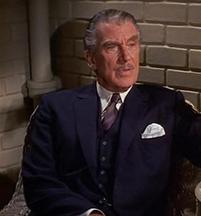 And then almost topping it all, there's that wonderful score. It's lyrical, wistful, very funny in several numbers, and even dark in a couple. Not only that, but it has a joyful title song that's reasonably well-known to people, in part because it was used effectively in a fun TV commercial for United Airlines. However, there's always been one thing that has frustrated me about Take Me Along. And that's the inability to find any video of that title song with the original stars. There are several numbers in Broadway history that are considered iconic, magical theater moments. One is in My Fair Lady when Eliza finally learns to speak properly and the the actors break out in "The Rain in Spain." Another is from The Music Man when the hereto silent Winthrop suddenly breaks through the crowd to joyously sing with his lisp about "The Wells Fargo Wagon" arriving. The title song of Take Me Along, from all I've read, is another one. It's an incredibly simple number, yet utterly charming, sung by two legends Jackie Gleason and Walter Pidgeon -- however it was when these two gentlemen break into a soft shoe that it apparently melted the house and stopped the show. But alas, I haven't been able to find any footage of the two of them doing their soft shoe. And have I searched. (I've even looked for any production of Take Me Along to find the soft shoe...) It gnaws at me every time I hear the song on the cast album, but happily the song is so charming enough that it wins me over on its town. But in the end, we have to make do with that original cast recording. It's a thoroughly charming performance, and when they stop singing and it goes into the musical bridge, that's where one's imagination takes over. To assist your imagination just a touch though, here's a photo. 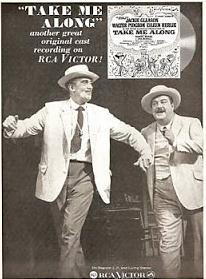 And here's the song. You supply the imagination at the music break.
12 Comments
Douglass Abramson
9/23/2013 11:21:17 am
Lovely song. I'm surprised that Hollywood never made a film version. Pidgeon was still a movie star, at the time and Gleason, despite being a huge TV and nightclub star, was almost desperate at the time to do any film part that wasn't a repackaged Ralph Kramden. Two marketable stars, a great score and a pedigreed book that touched on middle-class nostalgia. It sounds like a film would have been huge, at the time.
Robert Elisberg
9/23/2013 12:07:37 pm
While I clearly agree with you, I think some of the reason is -- as I note -- what the competition was. If you were a movie studio looking for Broadway musical properties, you had treasure chest of show to choose from during not only that year, but that era.
Douglass Abramson
9/23/2013 12:13:12 pm
Dick Van Dyke and Julie Andrews re-teamed in a musical version of Shop Around the Corner? That does sound like the ultimate unmade movie musical. Please don't tell me that she made Star! instead. Did She Loves Me share any score with In the Good Old Summer Time, or was it a totally fresh take?
Robert Elisberg
9/23/2013 01:05:54 pm
"She Loves Me" is all original songs, and is truly one of the great Broadway scores, written by Sheldon Harnick and Jerry Bock, the team the wrote "Fiddler on the Roof," "Fiorello!" and "The Apple Tree." The score is so good that when the cast album was released, the record company agreed to do a rarity for the time: put out a two-album set.
Gary Wright
5/25/2014 10:57:24 am
I agree totally! "Summer Holiday" (even though not a version that had the marvelous Merrill score) seemed to have been Hollywood's musical take on "Ah Wilderness." The Bway revival scored nothing but raves out of town & then came in under-financed counting on the NY Times to support it & when they didn't it just bowed away gracefully. Big River opened the next day & it got the support that Take Me Along was hoping for. It really is a wonderful story of 3 very different stages of love relationships & the Bob Merrill score is terrific!
Robert Elisberg
5/26/2014 12:52:38 am
Thanks for your note. Yes, under-financed is a killer. But it's still a shame, given how well it did out of town, and how good the score is. And from what I gather -- alas, still not having seen it -- how good the show is.
Roy Blair
7/13/2014 04:35:12 am
Robert, Many thanks for posting this gem of a song! Listening to it takes me back to my early radio DJ days in Ohio. We were fortunate to play whatever songs we chose, and this was one I liked to play often. I hope others happen across it as I did today! Best Wishes, Roy
Robert Elisberg
7/13/2014 07:46:33 am
Roy, thanks for your note. It sounds like you had a great show... 2/19/2015 11:40:39 pm
I too have always loved this score and album so, when the revival came to town in 1985, I got tickets to a preview performance (luckily, as it turned out!). It was quite good, but its flaws were apparent. The book is a bit "clunky" for today's audiences and could have been streamlined a bit more. The replacement of the "Beardsley Ballet" (yes, this was the era when nearly every musical still contained a "ballet" number) with "If Jesus Don't Love ya,' Jack Daniels Will" to open act 2 was a major help. The biggest mistake was ignoring that this musical was a (multi) star vehicle, and while they cast solid Broadway performers, they weren't stars. The first several scenes in act 1, while introducing the characters, setting, and establishing the plot also contained frequent references to Uncle Sid, Uncle Sid, and Uncle Sid and when he finally bursts on stage in his own production number (Sid, Ole' Kid) and it's Kurt Knudson, there was a let-down that couldn't be overcome. I and others kept watching him and mentally trying to project Gleason over Knudson. Mind you, Kurt's performance was top notch Broadway, as was Beth Fowler's, but, like so many musicals of that "Golden Age" you can't revive the star vehicles (which many were) with comparitive unknowns. Even David Merrick knew that when he kept Hello Dolly, a hit in its own right, running for many, many years by putting a cavalcade of stars in the title role.
Robert Elisberg
2/19/2015 11:59:50 pm
Dear Robert, Thanks much for your note and interesting comments. Lucky you to have seen the revival. I think it's a reasonable to accept that some things can be wonderful but written for their time's conventions. Also, I've long been a fan of withholding an entrance for a character to build up expectation (something stars or producers today don't all support, missing the point that it makes the audience anticipate them all the more) -- *but* if you do that, you have to make it pay off. And your observation of waiting for Jackie Gleason and getting Kurt Knudsen is a sharp one.
Robert Wendel
2/20/2015 12:05:19 am
Did you know that there *IS* a video of Jackie Gleason & the chorus doing his entrance number "Sid, Ole Kid?" It was tpaed (filmed?) for a CBS special in 1960 called "The Fabulous Fifties" which also is the source for several videos of Julie Andrews and Rex Harrison doing bits from My Fair Lady which have been posted on YouTube but, sadly, the Gleason number hasn't made it the yet.
Robert Elisberg
2/20/2015 12:40:54 am
Absolutely no idea of that. Terrific. One more thing to keep an eye out for and search. Thanks. Now I have to ramp up my hoping that someone filmed the "Take Me Along" soft shoe... Leave a Reply. |

Elisberg Industries gets a commission if you click here before shopping on Amazon.

AuthorRobert J. Elisberg is a political commentator, screenwriter, novelist, tech writer and also some other things that I just tend to keep forgetting. 

Feedspot Badge of Honor
Archives
June 2024
Categories
All
|
 RSS Feed