|
I thought we'd end our Opening Day celebration with a graphic that might give at least a small sense of why the day was All Baseball / All Day. I subscribe to MLB.TV, which allows members to watch every baseball game live, but also offers archives of the games if you miss them, and "shortened" versions of the games that edit out all the down-time and only show the pitches. It will not shock anyone here to know that I pretty much just watch the Cubs games (on the service, I'll watch other games on TV), though occasionally I'll put on different teams. As it turns out, MLB.TV keeps a record of who watches what and for how long. And a few weeks back, as Spring Training began, I got an email from MLB.TV with information they hadn't ever sent in the past. I have to admit, it surprised even me. A lot.  Wait, seriously? I was in the "Top 1%" of Cubs fans???! And the "Top 9%" of ALL viewers in the United States???! I don't know which of those two is weirder. Still, in semi-defense of myself, I have a theory for this: I work at home, and spend most of my time at my desk in front of my computer, typing away. And while most baseball teams play their games at night, the Cubs play the majority of their games during the day -- when most people (including Cubs fans) are, y'know, at work. Or school. So, they can't put MLB.TV on to watch even an inning of a Cubs game, let alone the full game. But I can. And...well, I do. (Okay, not every game, and not every inning. I do have a life, within speaking. And it's generally on in the background as I work. Generally. And we're talking home games only for day games, because most of the Cubs away games are at night.) And since most baseball games for every other team are at night, most people have a great many choices of things they want or need to do at night when games are on. Watch TV. Stream movies. Study. Read. Have dinner. Get together with friends. Actually deal with your family. And yes, of course, watching a baseball game falls in there, as well, but probably not every night for 162 games. For three hours each game. But for half the season, 81 games, there I am working at my desk at home, and putting the Cubs games on. Not all of them (many are at night), and not the full games, but for at least part of all of them. And even when the Cubs are playing at night, I might put the game on for a while, or check the best innings of an archived game. And the end result of that is --  So be it. What can I say? That's what the statistics show. I can only accept the reality, explain it the best I can, understand that's it's a bit weird even with a reasonable explanation, and have a fine old time watching baseball and following the Cubs. While working!!! (Yes, I'm really, actually working when the games are on. Most of the time.) Play ball!
0 Comments
And as a baseball bonus, we return you to maestro Riccardo Muti, from 2012 when he threw out the first pitch at a Cubs game. I find it adorable that Muti seems to love the Cubs, particularly since he's from Italy and didn't grow up on baseball or perhaps ever played it at all. But we know now that he's a lefty. Not the same form on the mound (or front thereof) as on the podium, but he did get it to the plate. By the way, listen closely in the background as he walks to the mount. The P.A. is playing Beethoven's 5th Symphony. To help celebrate the day, we'll start the year as is our tradition -- with the Chicago Symphony Orchestra and Riccardo Muti (in a Cubs jersey) playing “Take Me Out to the Ballgame.” I think it was done in honor of the Cubs 2016 World Series, their first in 108 years, since the video was posted on November 6, 2016. And the musicians are in street clothes, but many are wearing Cubs paraphernalia or blue. It's a wonderful and fun arrangement, too, not trying to overwhelm such a small, charming song with orchestral bombast, but arranged with an almost old-timey feel. And Muti seems to be having a good time with it all. A couple days I saw a long, half-hour video of a reunion of sorts of many cast members from the 1993 movie “Groundhog Day.” It was because the City of Chicago named Feb. 2 to be "now, forever more, in perpetuity, over and over again, “Harold Ramis Day” and had a big event about it. (In the late 1990s, Ramis moved back to Chicago, where he was born. In fact, he specifically moved to Glencoe -- not where he born, where I grew up…) The celebration started in the city at 6 AM, when participating radio stations all played “You Got Me, Babe.” The main event too place on Navy Pier, where a bunch of restaurants there played the movie. Bill Murray was there and many others from the cast, including his brother Brian Doyle Murray (who played 'the Mayor'), Marita Gerighty ('Nancy'), Robin Duke (who was the waitress) and others, as well as videos sent in by some cast who were unable to make it, like Chris Elliot and Stephen Tobolowsky, who played the annoying insurance man 'Ned Ryerson.' U.S. Senator Dick Durbin of Illinois spoke, as did Harold Ramis's widow Erica, as well, who made a very nice, short speech. And Alderman Brendan Reilly makes the city's official proclamation. The event concluded with "Mayor" Brian Doyle Murray calling out the groundhog to find out if it saw its shadow. One thing I found notable is that when the emcee introduced Brian, he was stopped by Bill who said he wanted to go before him. The sense I got from his subsequent comments was that he wanted to be the one to introduce his brother, which he does simply, but with very loving words. If you're interested, here is 30 minutes from the event. It's filled with overflowing affection. But I'm going to do this is two videos, because the main one leaves out the very opening, which is worth seeing. I did find a much shorter video though that has it, so after about 30 seconds, when the host says, "Thank you Richard Henzel. You probably recognize Richard, he's one of the original D.J. voices you heard over and over and over and over again in 'Groundhog Day'" -- you can then stop and click over to the main video. And here's the main event -- What an utterly amazing season for the beloved Northwestern University football. Going 8-5 and a bowl win...when at the start of the season (after only win last year, and just two wins the year before -- and then the shameful hazing scandal before the season began with some players leaving the school and parting ways with the coach, and playing instead with an interim coach, hired only six weeks before the first game) most people reasonably would have said that two wins would have been tremendous. And yes, the interim coach David Braun was signed to a five-year contract. 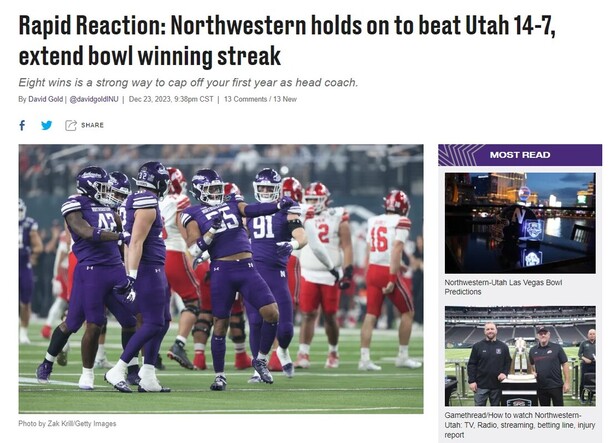 Very sorry to see the passing of Dick Butkus, the Hall of Fame middle linebacker of the Chicago Bears. He was pure Chicago -- he played his entire career in Illinois. He grew up on the Chicago South Side, went to Chicago Vocational High School, attended college at the University of Illinois. And then played for the Chicago Bears. When the Bears had Butkus and Gale Sayers (picked #3 & #4 in the very same 1965 draft! Man, what a draft that was...), the team was usually awful -- yet they were as great to watch as any Bear team...because of watching just those two. In fact, even with Sayers -- as graceful, remarkable and entertaining a runner to watch as I've seen -- Butkus is the only defensive player who's made me look forward to seeing the Bears (or any) team *without* the ball. The quintessential Butkus play, that I saw often growing up was a runner getting the back, sweeping left with two blockers in front of him leading the way -- and then you'd see Butkus's body come flying in, knocking the two blockers aside, bursting through them and not only tackling the runner, but causing a fumble and recovering the ball. Here's how great Butkus was: in 1969, the Chicago Bears only won one game, they ended the season 1-13. They were terrible. Yet Butkus won the NFL Award for best Defensive Player of the Year. When ESPN did a special countdown on the 100 greatest NFL players of all-time during the NFL's 100th season, they named Dick Butkus #10. Despite playing on only two winning teams in his nine-year career (cut short by bad knees.) That's how great Butkus was. It should be noted, too, that when college football gives out their Linebacker of the Year award, it's called the Butkus Award. That, too, is how great Dick Butkus was. Here's the video evidence. But stick around for a bonus video -- a short, but glorious clip of my favorite play ever with Dick Butkus, that I remember as a kid and happily found. Yet for all his renown as a spectacular defensive player, my favorite play with Butkus that I remember when growing up had nothing to do with defense! When the Bears would kick extra points and field goals, they would use Butkus to block for the kicker, because he was so tough. Late in one game in 1972 (the video says "1971," but that's incorrect), the Bears lined up to kick an important extra point against the Philadelphia Eagles. But the snap was bad, and the ball got away from the holder -- who happened to also be the team's quarterback, Bobby Douglas. Meanwhile, as Douglas scrambled around to gather up the loose ball, Dick Butkus had the presence of mind (even as a defensive player) to realize that he was of no value in the backfield, and instead sneaked his way into the end zone. Now, I can assure you, at no time during the Philadelphia Eagles' game preparation was the question ever brought up -- "Okay, now, who will be covering Butkus?" And so, there Butkus was, almost literally just standing in the end zone all alone, no one close to him. Because who in the world would think of covering Dick Butkus. And when Bobby Douglas finally was able to control the ball, he ran around to his left -- happily being a left-handed thrower, and happily Butkus (perhaps knowing this and in part, too, because he was lined up on the left) had run out to the left side -- and so Douglas, being a quarterback, spotted Butkus entirely by himself in the end zone. And threw him the ball, which Butkus simply stood there and caught, for the extra point. But that's not the best thing about the play. What happened next made the play special -- all the more so when compared to this era of player celebrations and choreographed team dances when they do something good. When Butkus caught the extra point, he didn't celebrate, he didn't dance, he didn't spike the ball -- instead, he just turned to the Eagles' defender who was rushing towards him, but too late...and politely, and utterly sardonically held out the ball for him. In perhaps the most gracious, "in your face" move you will ever see. At which point the frustrated Eagles player just thwacked the ball away. And best of all, as proof, here's that video! |

Elisberg Industries gets a commission if you click here before shopping on Amazon.

AuthorRobert J. Elisberg is a political commentator, screenwriter, novelist, tech writer and also some other things that I just tend to keep forgetting.    

Feedspot Badge of Honor
Categories
All
|
 RSS Feed