|
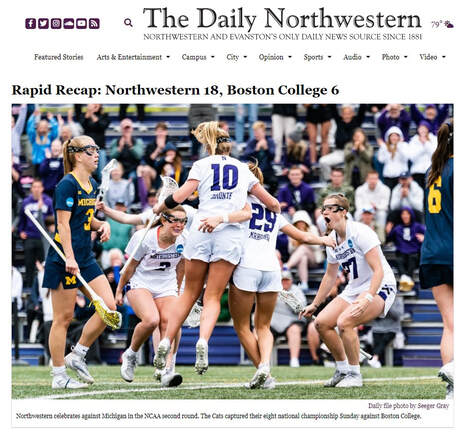
The short videos at the end of this are a bit unexpected and uncommon from what I generally post here, but somewhat fun, I think. But first some background. It's been quite a week for women's sports at the beloved Northwestern. The other day, the women's golf team won their first-ever national championship. And yesterday, the remarkable women's lacrosse team qualified for tomorrow's national championship finals by winning their semi-final match against Boston College -- coming back from an 11-6 deficit to win 12-11. This was a big deal, since Boston College beat Northwestern last year in the finals -- after Northwestern had beaten Boston College in the finals the year before. And the reason I call them "the remarkable women's lacrosse team" is because that win in 2023 was the Northwestern women's team eighth national championship in 18 years under coach Kelly Amonte Hiller. The finals this year, to be played on Sunday at 9 AM Pacific Coast time, will be broadcast on ESPN. It'll be a tough contest, against #1 ranked North Carolina. Northwestern is ranked #4. As it happens, when I was back in Chicago last month, I was staying in Evanston and went to the campus and wandered around. And at one point, I came across a practice field by Lake Michigan. And there was the women's lacrosse team practicing. I took some short videos and thought this would be a proper time to post them. One in particular is offbeat and amusing. If the "start" icon isn't showing, just tap on the image, and it should show up. This first is a 35-second video of the players in a sort of "shoot-out" scrimmage, practicing their one-on-one moves against the goalie. (You can see Lake Michigan in the background.) And this second video is...well, I'm not exactly sure what the point of it is. They team was at the far end of the field, so the details are a bit far, though I tried to zoom the lens as much as possible. But what they're doing -- other than having great fun -- was sort of bewildering to him, though a treat to watch. Basically, they seem to have split the team into two sides and appear to be playing a sort of dodgeball game, but with more than one ball and with what might be a small lacrosse ball. Though it looks a touch bigger and softer. Why they are doing this...I don't have a clue. Perhaps it's to develop hand-eye coordination. Or to develop teamwork or camaraderie. Or maybe it's just something the women love playing, and it's a treat the coaches give them as a break during practice. Whatever it was, it went on for maybe 10-15 minutes. And they were having a really wonderful time. (You'll hear the cheers at the end.) And considering they've won eight national championships in 18 years and are in the finals tomorrow, it seems to work. Here are 25 seconds of it.
0 Comments
Just a bonus video that I suspect very few people here will be interested in watching. But that's okay, it's only a bonus. However, when I posted the breath-of-fresh-air video of the final putt which clinched the first-ever NCAA National Championship for the beloved Northwestern's women's golf team, it was buried at the end of an article about Trump hell. And the championship deserved better. It deserved it's own posting. It deserved it's own headline. So, here's an an eight-minute video on the final round. (It's posted by NU Athletics, so it will not come as a shock that the only shots they include are by Northwestern players.) I'll give away the ending -- the Northwestern women's golf team wins the National Championship. Its first ever. When I was back in Chicago -- Evanston actually, staying just a few blocks from the beloved Northwestern -- I saw the news story on how the Trump administration (in its ongoing fascist effort to destroy education in the United States) had added Northwestern to its list and was demanding "changes" or else they would freeze $790 million in federal funding from the school. This stems from, as the New York Times stated it, Trump team "accusations of racial discrimination stemming from their efforts to promote diversity." As the article later notes, Northwestern (a Big Ten university) is the first non-Ivy League school to have funding from the Trump administration targeted. A spokesman for the school, Jon Yates, said -- "Federal funds that Northwestern receives drive innovative and lifesaving research, like the recent development by Northwestern researchers of the world’s smallest pacemaker, and research fueling the fight against Alzheimer’s disease. This type of research is now at jeopardy.” Before we get to that, I think it's important to know what this actually means, and that's it's not just "spokesman fluff". When he says "recent, that "world's smallest pacemaker" was announced literally less than two weeks ago, on April 2, and it's utterly remarkable. Jaw-dropping breathtaking. Whatever you may have in mind about "world's smallest pacemaker," you almost certainly might want to think smaller -- and even that's not the only thing that's stunning about it. The device is so small, it can be inserted with a syringe, and then dissolves after it’s no longer needed! Yes, that's a pacemaker. And yes, that is small. And it dissolves when not needed. Here's a 90-second video about it -- And that's the thing about this fascist Trump effort -- accepted and enabled by MAGOPs in Congress -- to destroy education. No doubt the base (and the word was never more accurate) loves when its party tries to undermine and shred education by freezing funding for all those "elites." Except what so much of the federal funding goes for is critical research that impacts the lives of everyone -- Red, Blue and every color in between -- and also helps the U.S. lead the world in scientific and medical advances. The $2 billion in funding that Trump/MAGOPs now want to freeze may be a joy to the base, but they might want to find out first that the bulk of the money goes for medical research into cancer and Alzheimer's Disease (neither of which discriminate on the basis of political belief...), and also Harvard-based hospitals, like the renowned Mass General and Boston Children's Hospital. Neither of which discriminate on the basis of...oh, you know. If you (whoever you are) ever need and can benefit from the medical care or scientific advances from any of this research that Trump/MAGOPs are trying to freeze, because they want to destroy education and have it heel to their fascist beliefs, just know what could be lost could affect you or your loved ones. And leadership in the fields might now go overseas. That's what this is about. Not falsely presumed "elites" or the MAGOP-hated "education." Which is why I was thrilled to see Harvard turn down the Trump/MAGOP demands, even if it meant losing $2 billion. It will hurt Harvard -- but it will also hurt all Americans, because they're who benefit from medical advances and needs. They and everyone in the world. As Harvard President Alan Garber said, spot-on properly: “No government — regardless of which party is in power — should dictate what private universities can teach, whom they can admit and hire, and which areas of study and inquiry they can pursue.” I must assume there will be lawsuits from Harvard and all the universities under threat of their government funding being frozen, including of course Northwestern. So, hopefully, they will either get to keep their funding for research or won't be blocked. In the meantime, though, great for Harvard. What a courageous, important stand to take. Which leads me to end with this from Tom Lehrer. To be clear, it's a comic song that has nothing to do with medical research (though does with scholarship), and is really just a chiding number about what a football fight song should be for the school. But its title fits perfectly, and so that's why we're going with it. "Fight Fiercely Harvard," indeed. Well, I'm back in Los Angeles, and the elves have left the place in reasonably good shape and didn't leave the refrigerator completely raided. I'll have something else later today, but while I'm unpacking and reacclimating I thought it proper to repost an article I wrote eight years ago on an earlier trip to Chicago. It's about one of my several favorite restaurants, Charlie Beinlich's, of which I've never come across anything like it in Los Angeles. It's very low-key. Began life over 70 years ago as really pretty much a truck-stop tavern in the suburb of Northbrook (basically across the street from Glencoe, where I grew up -- perhaps on that side of the road because Glencoe was dry, until literally the 1970s. Yes, really. In fact, I believe that was the case for all the Cook County suburbs along Lake Michigan because Evanston -- that borders Chicago to the north -- was the world headquarters of the WCTU, the Women's Christian Temperance Union). Mounted fish on the wall. Only about a dozen items on the menu, at most. But what they serve is all so good, and the welcoming service, never feeling rushed even when the place is packed (which is usual) is a joy. Here's more about Beinlich's. Beinlich's Redux April 26, 2017 I was going out to dinner with a friend the other day, trying to figure out where to eat. And I started to pine for a place I dearly love in the Chicago suburbs nearby where I grew up, called Charlie Beinlich's. It's not that there isn't a Charlie Beinlich's in Los Angeles, it's that there isn't a place I know of that's even close to it. And so I must do without -- but always go there when I return to Chicago. I've wrote about the place earlier in the year when I was last there, but realized that it deserves more than just a description of lunch -- though for Beinlich's that a fine starting point. Beinlich's (or to put it properly and in full, Beinlich's Food and Tap) is even a bit odd for Chicago, though it's very Midwestern, and so there are places that are at least somewhat similar. But Beinlich's is idiosyncratic. It began life as a truck stop probably at least 60 years ago, probably longer. (That alone, a 60+ year old restaurant is uncommon.) Indeed, it's the kind of place that reinforces the cliche that if you want to find the best food in a town, follow where the trucks go to. (I don't know if the cliche is true, but it sure holds at Beinlich's.) They actually close for two weeks in the height of summer, during August, so that they can go fishing. Really -- there's a sign they put out front that pretty much says, "Gone fishing." For that matter, they're also closed on Sunday, the busiest day of the week for more restaurants. But like their August closing for fishing, they want their Sunday's off. Monday's too -- they want their two-day weekend. And they don't take credit cards. And Beinlich's being Beinlich's, they don't even list their phone number on their website. Hey, they've been there for over 60 years. People know them, there's not much of a reason to call. But if you do and want take-out, they're in the phone book, look them up. Or you probably wrote their number down decades ago, it hasn't changed. The place isn't in Chicago proper, but the northern suburbs, in Northbook on Skokie Highway, not from the the oft-mentioned here Chicago Botanic Gardens and Ravinia Music Festival. Next door to the town where I grew up, in Glencoe. Beinlich's is basically a pine log cabin, with mounted fish covering the wall, lots of electric beer displays, and a wall-to-wall oak bar, along with maybe 20 tables at most. There is a sign when you enter that says, "Food is served for the convenience of our alcohol-drinking patrons" -- in other words, if you're going to eat here, please get a beer. There are no menus, just a small sign in the corner, but that's all they need because there are only about 10 items they make. Mainly, they make burgers and cheeseburgers -- thick, juicy, rich, fresh and meaty -- which you can get regular with chips, or deluxe with French fries and coleslaw. (And the fries are piping hot, and taste like little baked potatoes.) If you're a non-conformist, though, there's barbecued beef, a ham-and-cheese sandwich, grilled cheese, and they eventually added a chicken wrap, as lighter fare, and egg salad. Honestly, small as the menu is, I can't be accurate with everything since I've only gotten a burger deluxe there for the past probably 40 years. They're that good. (I think once, decades ago, I may have gotten a barbecued beef, but I can't swear to it. The two sides -- and hey, this is Beinlich's, they only need two sides, they're that good -- are shrimp cocktail (which my dad loved), and stunning chili. Okay, my dad loved that, too. As for me, it may well be the best chili I've had. I don't put any onions or cheddar cheese on, but just take it straight. Though I do like their oyster crackers, and dump a bit of red pepper flakes on. (Decades ago, after my dad had quadruple bypass surgery, he cut down on meat. So my mother -- a quiet, demure, small Midwestern lady, who used the telephone like Heiffetz played the violin -- called to ask if they could make a vegetarian chili. They said to call in the morning before we came in, say how many bowls we'd want, and if they hadn't made the chili that day -- something they did 2-3 times a week -- they'd put those bowls aside before adding the meat. Much as I love the Beinlich's chili -- and I said it may be my favorite -- I loved their meatless chili even more. It was lighter, and the flavors came through more, without having the meat predominate. Anyway, a couple of years ago, after my mother passed away, my dad and I were going to head to Beinlich's, so I decide to take on the responsibility and called ahead to ask about getting the meatless chili. Sorry, he said -- but disappointed as I was, I loved and preferred his reason. "We only did that for your mom.") Beinlich's even still has some staff who I remember from when I first went there when I was eight years old, though at this point it may be down to Andy, who began as a waiter, and is either the general manager at this point, or a part-owner now. But there are about 3-4 "new" guys which at Beinlich's means they've been there for probably 20 years. There are also now a couple of actually-recent servers. And the waiters, bartenders, and bus boys have always, for over half a century, always and only been men. But the last time I was in they had, for a very first time -- a young woman busing tables. Lunch usually isn't a big problem, though the place is always full. But if you show up for dinner too late -- like much past 6:30, the tiny waiting area and tiny enclosed porch is going to be jammed. That's more of a problem than you think -- remember, this is Chicago. If you get there too late at night in the winter, you're going to be standing outside in sub-freezing weather. But people will do just that. But ultimately, it's not a huge problem, because Beinlich's is fast. They zip you your food, and when you're done -- whoosh, it's gone. But somehow magically, you never feel rushed. It helps that everyone who works there, even when they're in a bit of a hurry, has always been Midwest friendly, and will give you time and chat if you need to. And if you want to linger a bit, that's okay. But because there's so much movement around, and a long line, people tend to be polite to others and empty their table. No, there isn't anything like Charlie Beinlich's in Los Angeles. Or most anywhere. I come visit Chicago every year – at times twice a year. And I had plans to come this Spring at some time. But there is a specific reason I came right now – a reason which even the elves back in Los Angeles taking care of the homestead understand. And they always insist that they understand little of what I do… Around 35-40 years, I saw an absolutely wonderful play in Los Angeles, called Translations, by the great Irish playwright Brian Friel. The first play of his that I saw years earlier was Philadelphia, Here I Come – a terrific show with fascinating staging, where the main character is played by two actors on stage at the same time (one his “outer self” who deals with all the people around him, and the other his “inner self,” where we see what he’s really thinking and the exchanges with others he’d like to have). It was nominated for a Tony Award as Best Play. He also wrote the play Dancing at Lunaghsa, which won the Tony Award as Best Play, and was made into a wistful, moody, lovely movie that starred Meryl Streep. So, when I say he’s a great playwright, I’m not kidding around. I’d loved Translations, which was staged in a small, Equity-waiver theater that only seated around 200 people. But as much as I wanted to see it again, in the intervening years hadn’t come across another production of it. In fact, it didn’t finally play on Broadway for another decade after I saw it. But as it happens, the excellent theater company I’ve written about there, the Writers Theatre (that began life literally in the back of a bookstore in Glencoe where I grew up, though now they built a magnificent facility there with two intimate stages – one so small, in fact, that it’s an homage to the original bookstore location) – is putting on Translations!! When I saw their new season announced a year ago, I’ve been anxiously awaiting for tickets to go on sale for this, finally got them, and planned my trip into town around it. (The Writers Theatre has an excellent company, and often uses actors from the Goodman Theater in Chicago. When they put on productions, the main theater critics from the Chicago Tribune and Chicago Sun-Times drive out to the suburbs to review the plays – and even the critic from the New York Times includes Writers Theatre productions when making his annual “what’s going on with theater in Chicago” trip. The Wall Street Journal has reviewed the company’s productions, as well.) All the more reason why I was glad that it was the Writers Theater putting Translations on. The play is a drama, though often rambunctiously funny, and even has a romance. It has to do with the importance of language and culture, and takes place in 19th century Ireland, when the British occupy Ireland and want to change the national language from Irish to English. The clever thing about the staging is that while all the actors speak to the audience in English, of course, the Irish characters (who only speak Irish) use an Irish accent and the British characters use an English accent – and so, although the two sides within the play can’t understand one another, we in the audience can understand them both. There is a terrific “Romeo and Juliet-like” subplot between an English solider and Irish girl – their sides are natural enemies, but the two are clearly attracted to one another. However, they can’t understand each other, though the audience can. There are times you want to yell out to the stage, “He’s telling you he loves you!!!” Oddly, something weird cropped up related to this. A month ago, I was watching the British talk show The Graham Norton Show on BBC America. One of the guests was one of my favorite actors, Chris O’Dowd (who, not shockingly, is Irish). He was telling a story about having recently appeared in a production of the play…Translations!! But further, as part of the story, he brought up that in the very first production of Translations, about 40 years ago, one of the actors in it was a young actor at the start of his career, Liam Neeson!! Since then, I’ve seen that it was put on by the National Theatre in London, and also the famed Abbey Theatre in Ireland. So, it seems to be done a lot in the U.K. And there even have been productions around this country – I just hadn’t been aware of them, despite keeping my eyes open for it. Obviously, not open wide enough. So, after going around 35-40 years looking for another production of Translations ever since I saw the play, and not coming across even a story about one, I then heard, within a matter of weeks, three different productions brought up! As well as found out about these other major productions, albeit when doing research. But still, something is in the water. But there's even more in the water than just that. Because it only recently struck me how far-more timely the play is today than when it was written. Keeping in mind that the play was scheduled by the Writers Theatre over a year ago -- and noting how in the news right now, the Trump administration not only is blocking the teaching of black history and erasing any DEI references from government documents, but also changing the name of the Gulf of Mexico to the "Gulf of America" and changing the traditional Alaskan Native name of Mount Denali (the highest peak in the United States), back to "Mount McKinley" -- the reality is that the play of Translations isn't just about soldiers coming to change Gaelic to English, which is close enough to today's headlines...but is about the British government sending in, literally a team of cartographers to change the maps from Irish locations to English names! In fact, how ripped from the headlines is this 40-year old play? Watching a video that the Writers Theatre made with its cast members discussing the meaning of the play, and describing it from the perspective of the ages-old battle between the British and Irish, there is a passage where they say -- verbatim -- that Translations is about "Trying to erase culture and language of that culture, the identity of that culture...Changing the names and places of Ireland to Anglicize them for English purposes." Little could be more current in America. As for the play, it was a joy to see after all this time. It was a great production, as the Writers Theatre's works almost always are. And the acting was impeccable, down to the minor characters. The only "hiccup" is that I could tell that some of the older audience (including those I went with) were having trouble with the thick Irish accents and pronounced British ones. But that's important to the play and the whole point of what it's about. It could be done without accents, I supposed, but it would be a lesser work for it. The play itself is excellent. It's not my favorite of Brian Friel's worth, and there parts that don't work as well for me as others -- the first act is a little slow, but it's absolutely critical for setting up the town, the people in it, the culture there, the relationships and history. Though for my taste, I'd have liked it a touch shorter. But it's so rich in texture, I understand why it's that way. And once the British arrive, the story becomes more involved. There is a lot left "uncertain" (or unexplained) in the play, but that's part of its point, as well. As Friel writes about the work, language and culture is what's important in the play, not the politics. And lack of clarity and misunderstanding and the criss-crossing of unshared history is at the heart of the play, so not everything is explained neatly. Because language when relying on translating is rarely exactly clear, while trying to be understood is the core of communication. All in all, I was so glad to see the play again after all these years. It's a thoughtful, rich, meandering and substantive work. Here's a short, 30-second trailer of the play when it was done at the National Theatre in London. It really doesn't to the play justice, or give all that much a sense of the substance, but hey, it's the National Theatre and at least is a start... And as a bonus, this is a short video from one of the actors in the original 1980 production -- Liam Neeson, as he talks about a (then) major revival of the play being done in Ireland two years ago, and then touring, ending at the famed Abbey Theatre. Being in Chicago now, I was talking last night with the elves back in Los Angeles taking care of the homestead, and they asked if I had any plans of going to Wrigley Field to see a Cubs game. I could hear the suppressed laughter in their voices -- because at game time last night it was 38-degrees. I should add that that's balmy...since at the moment (it's 9:30 in the morning, as I write this), it's 30 degrees.
My answer was that I've been to Wrigley Field in the cold weather and sitting for three hours in 30-degree weather is not high on my list of fun things, unless one is properly bundled up in winter gear. And often even then. So...no. |
AuthorRobert J. Elisberg is a political commentator, screenwriter, novelist, tech writer and also some other things that I just tend to keep forgetting. Feedspot Badge of Honor
Archives
November 2025
Categories
All
|
|
© Copyright Robert J. Elisberg 2025
|