|
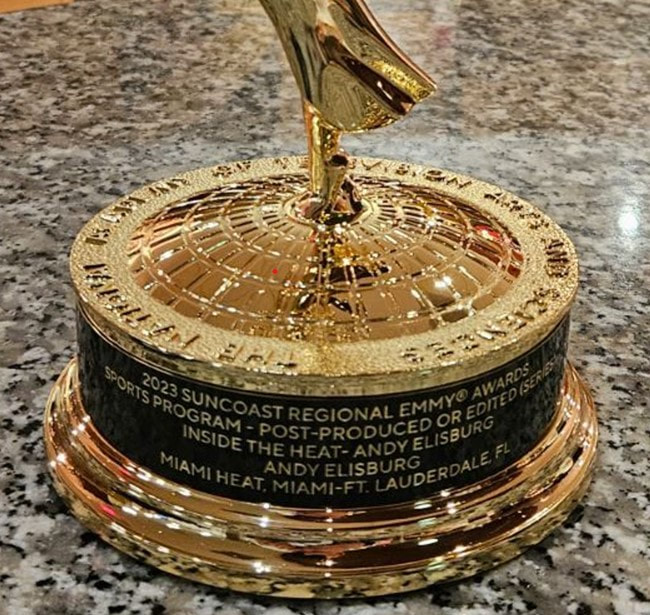
Put this in the Point of Personal Privilege File. I’ve written in the past of my cousin Andy Elisburg (his branch of the family spell it different, long story…), who is the Executive Vice-President and General Manager of the Miami Heat of the NBA. A couple of days ago, Ira Winderman of the South Florida Sun-Sentinel wrote a terrific article about Andy. It wasn’t a typical sports article though, and nothing that most readers would have remotely expected. But it’s one that tells a fascinating story worth repeating here. Normally, I’d just post a link to it, but I’m embedding the full thing below for two reasons – 1) I suspect that few people would click to go read a long article on my cousin and so posting it here is just easier, even if it’s unfair to the journalist and newspaper, and 2) for those who would click on the link, they wouldn’t be able to read it, because the newspaper is behind a paywall. The article is very well-written, and builds the story slowly. Adding unexpected twists and turns along the way. And the payoff is a yowza. But since it’s long (and deservedly so, for the full tale), I’m sure that most people who read it in the Sun-Sentinel are Miami Heat fans. Which is not the case here. So, I want to give at least a hint of what the article is about, though without giving away too much of the twists and turns. Two passages seem appropriate. One comes near the beginning – “Moments later, after weeks of negotiating hospital hallways, Elisburg maneuvers into the usual spot he has held on draft night in his three-plus decades with the franchise. “Aides are on hand. His blood pressure is regularly monitored. As the Heat’s No. 20 selection approaches, those numbers rise, not from the aggressive infection that led to these unusual circumstances, but because of the comfortably familiar stress of the situation.” So, that should give you an idea that this isn’t a normal sports story. Though, in fairness, the headline of the article sort of does, too. But it's too subtle. Really. Honest. And then there’s a second passage that stands out, which should make that point even more clear -- “It started late last season, as the Heat were fighting for their postseason life, when something felt off for the Maryland native who has come to be respected as one of the NBA’s ultimate salary-cap savants. “An infection that initially had sapped strength and mobility, suddenly had become life and death.” The fact that this comes even before the halfway mark in the story (or before halftime, to put it in basketball terms) should give an additional idea that there are indeed twists and turns to the tale. Among the many things that stand out to me is how upper management was so supportive of this. The “Pat” referred to throughout is Pat Riley, the former Los Angeles Laker Hall of Famer, and now president of the Miami Heat. And “Micky” and Nick” are the father and son owners of the team. Anyway, here’s the article -- A life-altering offseason has Heat general manager learning to walk again as he helps run an NBA team -- Ira Winderman, Sun-Sentinel, September 28, 2025 (That's Andy in the dark blue shirt and glasses. Draft night, June 20, 2025 photo courtesy of Miami Heat) It is June 25, NBA draft day. The practice court at Kaseya Center in downtown Miami again has been set up as a makeshift war room. All of the Miami Heat brass is there: Micky Arison and Nick Arison from the ownership wing, Pat Riley and Adam Simon from the executive wing, Erik Spoelstra representing the coaching staff.
All the while, one floor below, a rented ambulance is pulling into the P1 parking garage, where players, coaches and executives typically enter in privacy. Moments later, a gurney is rolled into the Heat locker room, with general manager Andy Elisburg then transferred by a nine-member medical team to a high-tech wheelchair. With the transfer complete, a sense of normalcy washes over the 58-year-old executive. “And the line I’ll never forget was from one of the therapy people, who said I looked happier coming to my office than most people do going to their houses,” Elisburg says months later. Moments later, after weeks of negotiating hospital hallways, Elisburg maneuvers into the usual spot he has held on draft night in his three-plus decades with the franchise. Aides are on hand. His blood pressure is regularly monitored. As the Heat’s No. 20 selection approaches, those numbers rise, not from the aggressive infection that led to these unusual circumstances, but because of the comfortably familiar stress of the situation. Moments later, Nick Arison, the team’s CEO, ceremonially hands the phone to Elisburg, as has been tradition at such a moment. Elisburg informs the league that the Heat’s selection is Illinois guard Kasparas Jakucionis. “When I was done giving the pick,” Elisburg says now, “I was able to reach over and hang up the phone. And the people in the back, all the therapists, and all the doctors were so excited, ‘He’s using his core! He’s using his core!’ Because, for me, I hadn’t had the ability. It was an effort to do that.” Fulfillment envelops the room, as Riley offers congratulations to all involved. Then, moments later, reality again for Elisburg, whose dramatic rise in the organization dates to his time as a media-relations assistant at the team’s founding 38 years ago. The curfew for Elisburg’s return to the Christine E. Lynn Rehabilitation Center has been set for 11:30 p.m. Another transfer from souped-up wheelchair to gurney. Back to the awaiting ambulance. Making curfew now the goal. “I was in my room by 11:15. So I made my curfew with 15 minutes to spare,” Elisburg says with a laugh. ••• When the Heat open training camp Tuesday in Boca Raton at Florida Atlantic University, Elisburg plans to be in attendance. How he gets there is not as important as how he got here, to this life-balance stage of the fight of his life. It has been a monthslong journey that largely has come in typical Heat stealth. The organization is bent on keeping the main thing the main thing, so Elisburg over these past few months has mostly conducted business as usual, even when it has been anything but usual. At times, Riley sat alongside on a hospital bed, briefcase opened as if at a staff meeting at 601 Biscayne Boulevard, not in Miami’s medical district. At other times, the Arisons have stressed time off, only to be met with spreadsheets, suggestions and, ultimately, the franchise’s biggest personnel move of the offseason, the cap-complex trade for Los Angeles Clippers forward Norman Powell. “All my time at Lynn I only missed one rehab session, and that was when we agreed to the Norm trade that Monday morning at like 9:30. I had a 10 o’clock rehab session and I just looked at my therapist and said I’m not making it this morning,” Elisburg says with a pride unique to the situation. “But I also had a 2 o’clock session, so I pushed the trade call to 3:30.” For weeks, months, a support system encouraged him, one that very much put Heat Culture and Heat Nation into capital letters. From the ownership branch to the executive suite to the coaching circle to the locker room to the business side, it was as if the entire organizational chart had visited at bedside. Beyond the Arisons, Riley and Spoelstra, other visitors included team executives Eric Woolworth, Sammy Schulman, Raquel Libman, Michael McCullough, the Heat broadcasters and former initial public-relations boss Mark Pray. “In a hospital,” Elisburg says now from his office suite, “it’s very easy to feel isolated. And I never took it for granted that so many people were willing to come and wanted to come. At one point in time, we limited it to certain days, because I had to make my work phone calls.” ••• It started late last season, as the Heat were fighting for their postseason life, when something felt off for the Maryland native who has come to be respected as one of the NBA’s ultimate salary-cap savants. An infection that initially had sapped strength and mobility, suddenly had become life and death. “We were playing against Memphis on the second night of a back-to-back, and I was exhausted.” Elisburg says, as he begins to retrace an offseason like no other. “I just felt extra exhausted. I canceled an appointment I had that day, and I said, ‘Let me just sleep in and go to the game.’ I went to the game that night. Before the game, I was feeling fine. I was out there for a while. And then I just felt really lousy. “I called back to the trainers and said, ‘When the doctors get here, let me know. I need to see ’em.’ I just felt really, really run down. My best friend (former Heat executive and college classmate) Marjie Kates saw me and was like, ‘You look gray.’ ” The vitals at the moment came back fine, but an infection was detected in his foot. “I didn’t stay for the game that night, and I started on antibiotics. Anyone who knows me, knows me not staying for a game is a big deal.” Days passed, with a return to better health, as the treatment with antibiotics continued. “It seemed like it was under control.” It was not — even as Elisburg continued with his work through the balance of the regular season, the play-in tournament and the playoffs. ••• “The day after the season ended,” Elisburg says of April 29, “I woke up in the middle of the night, and thought I threw a muscle in my back, one of those ones you get up and suddenly you fall right back down in the bed. It was like someone stabbed me with an axe in the back. “I’d pulled a muscle before, so I thought I’d pulled a muscle. “I got some medicine for it, stayed in bed for a few days. It was bad enough that I didn’t come to the exit interviews.” And got worse. “Two or three days later, it seemed to be getting better — but it never got really better. And then, over the weekend, it started feeling worse. I was having a problem sleeping, I hadn’t been sleeping at all. I thought I wrenched my knee. And it was getting worse.” Team physician Harlan Selesnick had scheduled a home visit for a few days later. In the interim, Marjie and the team trainers said it might be time to get to the hospital. “Me being me, I said, ‘I’m fine. I’m fine. I’m fine. I’m fine.’ ” On the scheduled day of Selesnick’s visit, “I started getting out of bed, and my left leg didn’t work. . . . which is probably as scared as I’ve been in my entire life.” Upon ambulance arrival at Baptist Doctors Hospital in Coral Gables, “I was a whole lot sicker than I realized I was. That’s where they discovered I had an infection throughout my body — in my knee, in my back. My kidney numbers, my liver numbers, everything was up and elevated. “There were people who were not quite sure I was going to come out of that.” Amputation of part of his foot followed, “amid concerns about my vital organs,” since his kidneys were essentially at dialysis level. Multiple surgeries ensued, “like five or six that wound up having to happen over the next week to 10 days.” ••• Medically, the worst was over. Now the work was about to begin, work unlike anything that had come before, even for someone who acknowledges far more time spent in the office than at home. “Nothing is more important than your health. I’ve heard it a million times. I’ve said it a million times. And I’ve meant it every time I’ve said it and every time I heard it,” Elisburg says. ” But when you can’t walk, it’s amazing what those words mean. “I want my life back.” So even amid those grueling rehabilitation sessions, ones that are still ongoing — now he is able to take steps through parallel bars while under close supervision — there has been a work-life balance. The body may have failed, but the mind remained sharp — salary-cap sharp, luxury-tax sharp, player-personnel sharp. “One of my procedures was happening the day of the lottery and got delayed and kept being delayed. And so it wound up happening during the lottery. So I get out of the operating room, I get to the recovery room that I’m awake, alert enough to bring my friends in to see me, and my first question is, ‘So who won the lottery?’ ” The Dallas Mavericks won, from the lottery seed the Heat would have held had they not made the playoffs. The moment was not lost on Elisburg, even in that post-surgical moment. “I said, ‘Well, that’s going to be an interesting thing.’ ” After three weeks at Doctor’s Hospital, the move was made to the rehab facility. “I had basically been in a bed for a month without moving. At that point in time, it was enough of a challenge just to be able to move, to be able to sit. It took like six people to be able to get me up to be able to sit on the edge of my bed, and I’m in agony of every step of the way of it happening.” It had become clear what the main thing actually was. “Pat and Micky and Nick, from the first time I got sick, basically were, ‘You don’t have to do anything. Do not worry about work. You need to worry about taking care of yourself and being healthy. We will cover whatever has to happen here. You worry about you.’ That was the first thing they said to me.” But the work also helped pass the time. “It was hard for me to sit in a hospital bed and sleep or watch TV,” Elisburg says. “And after a while, I said, ‘I’ve got to get something going.’ I started making some phone calls, started talking about the draft and trades and things of that nature. “When I would talk to Pat and Nick, I’d say, ‘Hey, I’ve got some information.’ Initially, it was, ‘You worry about you.’ I was like, ‘I need to do this. I need something to get my mind going.’ And it went to now we started to have regularly scheduled meetings. “There were times when Pat came over and we sat and just were talking, it was just there for support. And there were other times we had meetings and discussed what the next strategy would be. And we did it from my chair or my hospital bed. Mentally I was in a good place. Keeping things going with my mind was really good for me.” ••• That normalcy allowed for a degree of business as usual. Many outside the organization were not aware of the situation. “There are times I got calls from GMs during therapy sessions. Now, the old Andy Elisburg, he would have been in the lobby having a phone call if a GM called during therapy. Now, it was like, I’m doing my therapy, and when I get upstairs, I’ll return the phone call. I had to change my approach to, ‘I need to focus on me and my health now ahead of work.’ Which is, to anyone who’s known me for any number of years, was not me.” There also was no masking the situation as he dealt with other NBA executives and agents. “Usually you get to, ‘How you doing?’ I’d say, ‘Well, that’s an interesting question.’ I was pretty open with the people I know. I was fairly forthcoming.” No, not necessarily business as usual, but work getting done, trades made, players signed, cap ledger squared. ••• Back at his Miami condo since mid-July, with therapy on an outpatient basis, Elisburg is also again spending time at the office, again a fixture at the practice court during scrimmaging and informal player workouts. The logistics getting to that practice court have been simplified since that draft-night visit, even as normalcy remains a work in progress, including the inability to get to Micky Arison’s Hall of Fame induction two weeks ago. “That one hurt a lot, and I wound up with a little bit more infection in the foot. And I decided doing things crazy is one thing, doing stupid things is something else. “I’m probably (doing) about 80% of what I’d been doing at this point in time in September.” “I’m doing well. There’s still a lot of roads ahead,” Elisburg says. “I’m still dealing with some infections, I’m still dealing with pieces of it. “There’s nothing at this point in time that has had anybody saying I can’t walk. So I’m viewing myself as getting back to my life. “But I also can’t go without saying my incredible appreciation for my family and everybody at both Doctors Hospital and Lynn for what they did to save my life. “I walked into Doctors Hospital a lot closer to not being around than I realized then, and realized later. “The nurses and the doctors and the therapists and all the people at Lynn and what they did and what they’ve done on a daily basis to get me where it is, because Erik’s line is so true, it’s about getting 1% better every day. “Marjie was there every day at the hospital. My parents were there often. In fact, my dad also had to go to Lynn for therapy, so my mom was going back and forth to both rooms. “The care of all the doctors and all the nurses, all the therapists and all my home health aides are why I’m here today. Look, it’s unfair what happened to me and I can sit there and look at that. But I also look at it as, ‘Look, I’m the luckiest person in the world. I love my life.’ “I’m looking forward to the season and lucky that I do something that I have such a passion for and still am able to do it.”
0 Comments
Live from Des Moines, Iowa, on this week’s ‘Not My Job’ segment of the NPR quiz show Wait, Wait…Don’t Tell Me!, the guest contestant is University of Iowa basketball coach Jan Jensen – who coached basketball phenomenon Caitlin Clark during her college career. It’s a fun, lively conversation with host Peter Sagal, that includes stories about her grandmother who was a Hall of Fame college basketball player in the 1920s. And of course about coaching Caitlin Clark. This is the full Wait, Wait… broadcast, but you can jump directly to the “Not My Job” segment, it starts just before the 19:00 mark. As readers of this site know well, I’ve long written about my Internet friend Peter Breiner. For those new to the party, Peter is a remarkably accomplished musician -- composer, arranger and conductor. And that that’s not hyperbole – he has made 291 recordings (Yes, really. To put this in perspective, I don't even own 291 CDs...). Moreover, he wrote a weekly newspaper column, is a book author, had a radio program, and hosted a talk show on Slovenska Televizia (with the great title, Do You Have Something Against That?) that had the honor of being briefly banned for being too controversial. (Happy, all was forgiven, because in 2018 Slovak President Andrej Kiska presented Breiner with the Order of Ludovít Štúr, the third highest Slovak state decoration. Meanwhile, he lived in Toronto and then New York City for almost 30 years, and now resides in London.) Most recently, I posted the video here when he conducted the Slovak Philharmonic with the world premiere performance of his piece, The Devil in Moscow, a 50-minute suite adapted from his new ballet The Master and Margarita, based on the classic novel by Bulgakov. I bring all this up for because of a story that boggled me. It turns out that I knew of Peter Breiner’s work before I even knew Peter Breiner! And I’ll bet cash money that many people reading this (if not most) knew of him, as well. And therein lies the tale. A few weeks ago, Peter and I were discussing politics online (he grew up in Czechoslovakia, and has lived under repressive authoritarian governments, which drives much of his worldview. But that’s another topic). And in our text chat, he mentioned offhandedly having written a controversial arrangement of The Star Spangled Banner for the Athens Olympics. I didn’t know exactly what he meant and asked -- was it the anthem played for U.S. gold medal winners or used for some other purpose at the games? His answer floored me. He replied – “I wrote the anthem arrangements for all the countries.” Wait, what???!! Yes, it turns out that Peter Breiner wrote all 204 of the official arrangements for the 2004 Athens Olympics!! Moreover, I remember the one he did for the U.S. That’s because it was different and stood out, but absolutely beautiful and so moving. The reason it was controversial was because the music didn’t get loud and bombastic at “and the rockets’ red glare,” like most arrangements, but instead he wrote that passage very soft and gentle with violins, interpreting the action (he explained to me) as if you were on shore, watching the battleships at a distance through the smoke filling the harbor. I found it online. You may remember it, too. But even if not, I think you’ll be fascinated by it. Because by getting soft at that point, it allows the music to build and soar majestically at the end, making it all the more moving and impact, rather than hitting a high earlier and staying there. For all those who hated it (and many did), my sense is that far more loved it. I say that from my memory of the time, articles I've recently read and notably because the User Comments on YouTube for this are almost universally glowing. How it’s their favorite version, that they wish it was used more, and how it brought them to tears. I will add, too, for those who find the arrangement supposedly "sacrilegious," not only was there no "original" arrangement, since what Francis Scott Key did was write lyrics only to an existing piece of music -- but that music was a British drinking song! And it turns out that Naxos released an 8-CD set of all 204 of his anthems he arranged for the 2004 Athens Olympics. (For anthem aficionados, Amazon has the full set on sale now at 50% off for $45, which you can get here.) By the way, as “proof” of what he did for the Athens Olympics, and the controversy, and all the dealings with other countries and their interests and controversies, you can read a very interesting article here in the Washington Post that was written at the time. (There’s a very funny story in all this. New Zealand wasn’t happy with his arrangement, and sent his a few different versions done by others that they did like, preferring that he do an arrangement closer to them. It turns out that one of those they sent…was Peter’s own arrangement of the New Zealand national anthem!! So, that’s the one they went with.) And arguably even more interesting, this here is another WaPo article from four years later at the 2008 Beijing Games when it became clear that China had actually stolen all his copyrighted arrangements. Anyway, I found it all absolutely fascinating, and yet another of his many high talents I didn’t know. Here is that version of The Star-Spangled Banner he arranged. I will add that I love it, and interestingly, the more I listen to it, the more moving I find it. So, if you don’t quite know what to make of it at first, I would suggest you listen to it at least a couple more times. For most of such people (I think…), it will grow on you, as what he’s doing in his arrangement becomes clear. That said, I think there’s a good chance that many, if not most will love it at first hearing. Because, yes, it’s different, but it’s also wonderful. O'er the land of the free, and the home of the brave. Very sad to hear that the great Chicago Cub Hall of Famer Ryne Sandberg passed away yesterday of cancer. He was 65. Ryno had previously had treatment and been declared in remission. But a few years later, it sadly returned. A great player, but by all accounts, an even better person. He was an incredibly popular Cub. After writing that last night and saving the article for posting today, I got an email from my cousin in Chicago. All he said was how sorry to hear about Ryne Sandberg passing, and then adding "A real Cub legend and first class individual." Almost the exact same thing. There's so much that I'd like to say, and so little that I will -- just like my cousin Peter. Sandberg was in 10 All Star Games, won nine Gold Gloves for defense, received the Most Valuable Player Award in the National League in 1984, and was elected into baseball's Hall of Fame. With Ryno, who was so low-key, it almost seems best to just leave it at this, and a couple videos to speak louder and better. There are few games in baseball history that have a "name." But most baseball fans know "The Sandberg Game." It was a nationally television Saturday game on NBC with Bob Costas as the microphone -- on June 23, 1984. The season that Sandberg won the MVP Award. The Cubs were playing their top rival, the St. Louis Cardinals. Ryno came to bat in the bottom of the ninth inning, the Cubs down by a run, facing future Hall of Fame reliever Bruce Sutter -- a former Cubs. And he hit a home run to tie the game. Then, in the 10th inning, with the Cubs down by two runs, with a runner on base...and with two outs -- and again facing the great Bruce Sutter...Ryne Sandberg did it once more, getting another home run, to tie the game. His fifth hit of the day. The Cubs went on to win. This is the Cubs Hall of Fame Announcer Harry Carey (who earlier in his career announced for the Cardinals -- lots of Hall of Fame overlaps in this game, helping make it even more legendary...) with the call. All edited down to about four minutes. And second, we'll go out with this. It's Ryne Sandberg's Hall of Fame induction speech in 2005. It'll give a good idea on who he was. There have been many great Hall of Fame speeches -- this is considered one of the best. Live from Boston, on this week’s ‘Not My Job’ segment of the NPR quiz show Wait, Wait…Don’t Tell Me!, the guest contestant is Boston Red Sox Hall of Fame outfielder Jim Rice. He has a very personable, fun conversation with host Peter Sagal, along with an amusing story about when he got the call that he was elected to the Hall of Fame – along with his batting tip.
This is the full Wait, Wait… broadcast, but you can jump directly to the “Not My Job” segment, it starts around the 18:30 mark. Being in different leagues, the Chicago Cubs and Minnesota Twins rarely play each other. And today, the Cubs didn't just play against Minnesota, but played the game in Minneapolis for (I think) the first time. The Cubs have a very popular (and good) lead field reporter named Taylor McGregor. (She has a degree in broadcast journalism and does work for ESPN.) She also has a wonderful sense of humor, and is often the target of joking with the booth. Anyway, someone on the broadcasting staff had the fun idea, being in Minneapolis, to have her film an homage to the famous opening of The Mary Tyler Moore Show. And what I suspect is what prompted the idea (along with being in Minneapolis) is the additionally fun thing -- that they called their version "Mary Taylor Moore." The crew apparently didn't have time to get the music rights for the video (or perhaps it cost too much, but I really think this was just a spur-of-the moment thing), so they added some similar-ish style music. But they got the graphics right. No, the video isn't a spot-on recreation. (And as Taylor McGregor notes afterwards about the iconic TV series from the '70s -- "I wasn't alive in the '70s." And later adds that she's never even seen the show. Which is why she asks, "How did I do?") But it's nonetheless very cute. The quality of the video is definitely good, but since I had to record it off my computer monitor, it's not the best. However, the sound is soft, so it might help to increase your volume. Also, it's possible that it might take a few seconds for the video to load -- if so, be patient, it will get there. But that just might have been for when I was uploading it the first time. Anyway, this is how they opened the Cubs broadcast today. |
AuthorRobert J. Elisberg is a political commentator, screenwriter, novelist, tech writer and also some other things that I just tend to keep forgetting. Feedspot Badge of Honor

Archives
December 2025
Categories
All
|
|
© Copyright Robert J. Elisberg 2025
|