|
We take this moment for a point of personal privilege. (I was going to say that it was “political”, as well, but that would have been far too much alliteration on a Sunday morning.) As I’ve mentioned in the past, I’m friends with a good fellow named Nick Melvoin who sits on Los Angeles School Board, and was the only school board member re-elected in 2022 with over 50% of the vote in the primary so that he didn’t have to be in a run-off. I bring this up again today for s specific reason. But first it's important to note that Nick has had an impressive career, even for such a young one -- He’s a graduate of Harvard and got his MBA in Urban Education from Loyola Marymount, from which he went to teach at an inner-city middle school in Watts, coaching the soccer and baseball teams, and helping start the school newspaper. He also has a law degree from NYU -- and worked in the Obama White House with the Domestic Policy Council...as well as the US Attorney’s office as a legal clerk, getting involved in civil rights investigations. Oh, and he runs Camp Harmony, a camp for kids who are experiencing poverty, which he started working at as a counselor 21 years ago. So, while I can be accused of bias for supporting the son of friends, I think it’s fair to say that my bias is highly justified. I’ve brought up previously that Nick is running to replace Adam Schiff in California’s 30th district. It’s a challenging race with many candidates, including several with reasonably-known elective credentials. But that’s why I was exceedingly pleased to see that the Los Angeles Daily News just endorsed Nick in the race. 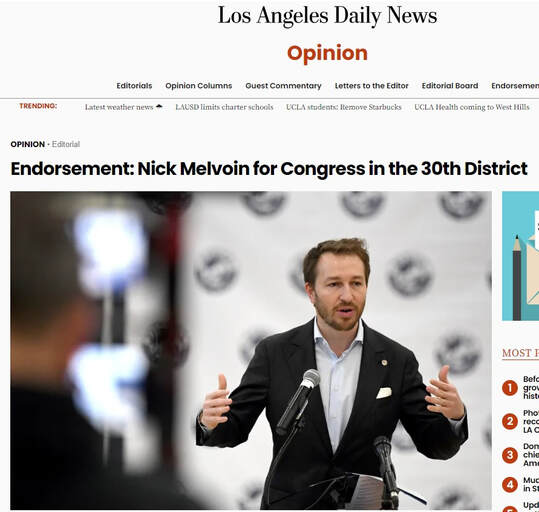 Among the lengthy things the paper wrote, they explained, "If voters want sensible, scandal-free and balanced representation, Nick Melvoin is an excellent choice. He has our endorsement." And all the better, he also just picked up an endorsement from Henry Waxman, a popular, long-time Congressman in Los Angeles who represented various districts in the city ("various" because of redistricting) for 40 years. And previously, Nick was endorsed by Rep. Colin Allred, the congressman from Texas who is challenging Ted Cruz for the Senate. It remains a difficult race because replacing Adam Schiff is so high-profile, making the district an important one. But getting such endorsements for such a young candidate is seriously impressive. But then, that's because Nick is, as well. I close in full disclosure that I will be heading over soon to watch the Super Bowl with his parents. I do this in part because of the football, in part because of the company, and in important part because they serve Chicago deep-dish pizza. I have my priorities.
0 Comments
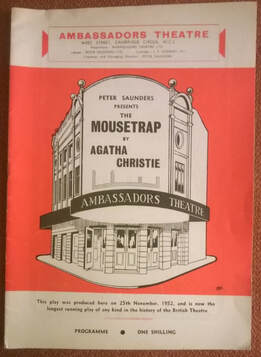
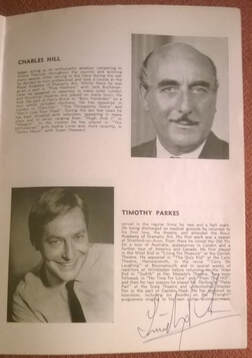
In the past, I’ve periodically mentioned my cousin Andy Elisburg who is the General Manager and Executive VP of the Miami Heat NBA team. (As I’ve noted before, but for those just joining the party, no, that is not a typo, but his wing of the family changed the spelling very long ago.) And today, we head in that direction again. But not to Andy. Instead, we take a detour. One that brings us to his niece, Abby Berger, who is a junior in high school. The other week, her grandmother Nancy sent me a copy of a short speech that Abby gave. Now, I often get sent things that friends, relatives and acquaintances have written, including pieces that their children wrote -- which they figure, as a writer, I’ll be interested to see, and even impressed by. And I do like to see them. But a little perspective is needed here first before going any farther. The challenge when sent material is how to respond. Because over the years it's part of what I do for a living, and I’ve been given screenplays, novels, articles and stage plays written by professionals, some of them Tony, Emmy, Writers Guild, and Humanitas award-winners, to get my reaction and suggestions, and have also edited several books, as well, and more, going back to when I was the head writer in the Universal Picture publicity department. I always tell the person first that I will be totally honest with them, if that’s what they want. (They always say, yes, absolutely -- though most don’t mean it. What they want to hear, and often even expect, is "Not since William Faulkner has literature moved me so much -- and that it my brutally honest opinion.") But, yes, when the person is not a professional I do always keep in mind the background of the writer and the work’s intent. Still, though, because I always really do try very hard to be honest -- and polite -- it’s very often a concern wondering what I’ll have to say when I dive into a work, holding my breath that the piece will be nicely done. I thought Abby’s speech was superb. Not just for the writing, but for what it said. Explaining her experience living in a world most people never see, or even consider. And a world that today is especially deeply important and meaningful. As her grandmother put it, a world where “we often have no idea what children, hear, see and process.” This was for her confirmation at temple, about being a child growing up over the years amid all the normal pressures someone young faces, just trying to find your place in the world and staying firmly who you are, when additionally surrounded by an outside environment that is very different, at times even hostile, from one’s Jewish homelife. I asked for permission to use Abby’s speech and whether she wanted me to use her name or preferred not. She gave her okay to both. Given what she writes, I'm not surprised. Though I nonetheless admire her decisions. And am glad because she deserves the credit. Here is her speech. I think it’s wonderfully written, thoughtful and moving. And very meaningful, most especially today. Shalom everyone, I’m Abby Berger -- and by now you know the prompt of my speech: how to explain to a room full of Jews what Judaism means to me. As poor Rabbi David knows, I struggled with this speech. On the surface, being Jewish is just what I am. I have the signature Ashkenazi curls, I love matzah ball soup, and I like to throw random yiddish words into my sentences for fun. I’ve always known these things. Yet I’ve been fighting to prove I exist ever since elementary school. One of my favorite Jewish concepts is Tikkun Olam. In your program, it is defined as “healing the world.” It can also be defined as “improving the world.” As kindergarten me saw a giant Christmas tree go up every December, and nothing else -- I decided that the way I would improve the world was through education. And that’s what I did. I taught my fellow classmates about Hanukkah every year, by bringing props and telling stories. With help from my mom, I even got the front office to put up a menorah and dreidels next to the tree, every year. I left elementary school quite proud of my accomplishments. Mazel Tov!- I had won! And then came middle school. This was the time of braces and growth spurts-I joined orchestra, and I learned about the “glories” of Algebra. This was also when I was properly introduced to the Holocaust. I learned about it from Hebrew school, and a little bit in 8th grade, but I also learned through books. The only Jewish characters I could find in chapter books were always about the Holocaust. So of course, I read them, and I learned. I kept this history in the back of my mind, but as a middle schooler, we tend to forget things, and I didn’t really think about it. Until one day, in orchestra, I saw a swastika carved into my cello. I don’t know if you’ve ever seen a cello up close, but it has a tough top coat- to get a scratch through is difficult. To find out that someone had taken the painstaking time to carve a symbol of hate on such an innocent canvas -- that was baffling for me. Talk about a wake-up call. I reported what happened to my teacher, and soon the school counselor gave a presentation on hate symbols and why they can hurt people. I then continued to educate those around me about Jewish holidays and the deliciousness of matzah ball soup. (although first I had to explain what matzah was). So I left middle school, proud I had made a difference. Mazel Tov! -- I had won! And then came high school. Oy. Gavolt. In between classes, extracurriculars, and learning to drive, I soon realized that I was the only practicing Jewish student in almost 2,000. To say I experienced some antisemitism is to put it lightly. Students would do the nazi salute and post holocaust memes, and teachers would let them get away with it, with nothing more than a warning. I’m sick of it. By now, I have come to realize that the common denominator for all of these incidents was that people didn’t know I was there. They didn’t know a Jewish student went to their school, and witnessed what they did. So I'm doing what I do best- educating. I remind my little Southern Indiana town that there is a whole world of people who are different, and some are quite close to home. Now, how does this answer the prompt? What does it mean to be Jewish as a public school student in Southern Indiana? It's the moment of hesitation to put on a Star of David necklace. It's not hesitating to correct someone's mispronunciation of a holiday. It’s the telling and retelling, and retelling, of the story of Hanukkah every December. It’s making challah. It’s eating- lots and lots of eating. It's keeping a list of anti-semitic moments I've experienced. It's the plan to use that list to start a revolution. These are all answers I’m sure Rabbi David did not see coming. For me, to be Jewish is to exist. To take up space, and learn, and educate. To hope for the better, but to start on the problem now. So Shalom, I’m Abby Berger. And I’m proud to say that as a Jew, I exist. We take a moment for a bit of Personal Privilege. Back in March, I wrote a piece here about a TV documentary series that airs in Miami called Inside the Heat that provides a look into the Miami Heat NBA team. And they just did an episode that devoted the full program to the 35-year career of my cousin Andy Elisburg who is the General Manager and Senior Vice-President of the basketball team. (No, not a typo, their wing of the family spells it differently) At the end of the article, I quipped that -- "I also believe that the show should be nominated for an Emmy next year as Best Program of the Year. Though I'm admittedly biased." O ye of little faith. It turns out that it wasn't just a quip, but a prescient one. Because bizarrely -- and happily -- I wasn't far off. Really. The other week, at the 47th Annual Suncoast Regional Emmy Awards -- the episode actually, really won an Emmy Award! Hey, like I always say here, I tries nots to steers ya wrong. And I'm not fibbing. Here's the proof -- 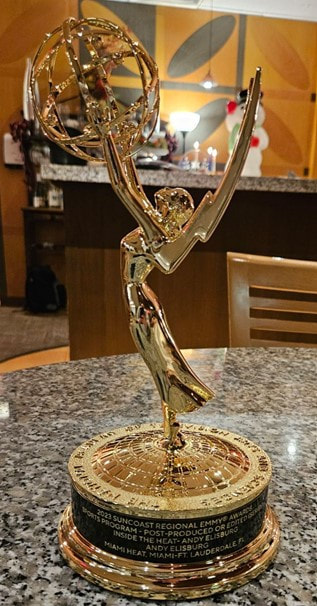 And just to show that, no, this isn't just a photo of a random Emmy statuette, here's a close-up of the text on the base for those who choose not to the use "zoom" feature on your computer -- 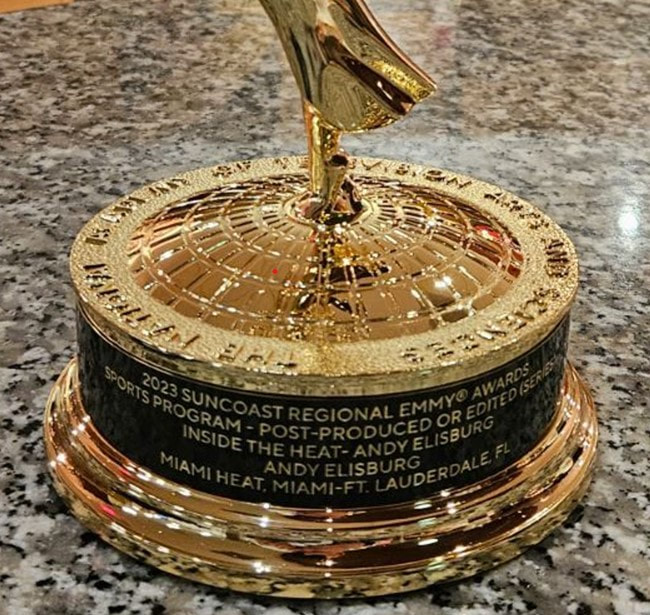 And as Andy ways -- "Working my way slowly to an EGOT..." Today, marks the anniversary of when Agatha Christie's play The Mousetrap opened on London's West End. That was on November 25, 1952 -- 71 years ago today. It's still running, after over 28,000 performances. By way of comparison, not long ago Phantom of the Opera closed as the longest-ever running production in Broadway history. It ran for 13,981 performances, over the course of 35 years. If it hadn't close and played for another 35 years…it still would be short of The Mousetrap. And that's if The Mousetrap closed tomorrow. Even the longest-running show in New York, off-Broadway's musical The Fantasticks, which had a remarkable run of 42 years and 17,162 performances fell far short, just over half as long. And again, The Mousetrap is still running. I have a theory about that. At some point long ago, it stopped by just a long-running play and instead become a tourist attraction, a stop to make when in London. As a kidling, I saw The Mousetrap on a family trip to Europe in 1966, the play's 14th year. A couple years later on another family trip, I picked up a poster which I have up on my walls. 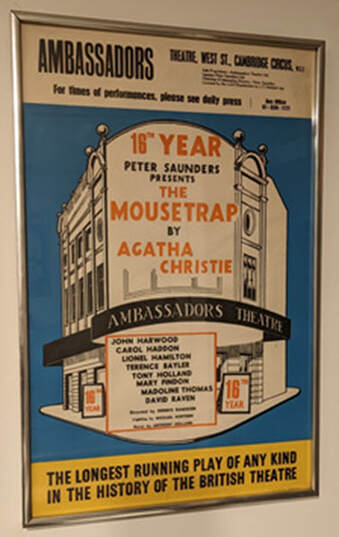 At the time, I was a little sorry that the poster had as many years as "16." Little did I know how paltry that number would be. When I saw the play in 1966, I went with my older brother. (Our folks went to a different play that day.) I was very excited about going, since I liked Agatha Christie mysteries and had heard so much about this monumentally long-running play. I'd read the novella beforehand, so I knew whodunnit -- but at intermission I asked my brother who he thought the killer was. (Don't worry, I won't give it away.) He kept changing his guess -- "No, wait, don't tell me, I think it's..." -- and I just politely sat there smiling at him. (Fun fact: He didn't guess it.) I do remember after the play, when we waited for our parents to leave the theater next door -- it was a matinee -- the cast eventually left the Ambassadors, and we spoke with one of the actors, and I still have the program he signed. I didn't know who he was, and while he might have done a lot in London theater after that, he didn't become known in the U.S. But it was fun. And I still have the program. (Sorry, "programme.")
The Mousetrap has never played on Broadway, though there are plans to finally do so. In fact, they were trying for this year, but clearly that scheduling didn't pan out. That said, if you've seen the 2022 movie See How They Run with Sam Rockwell, Saoirse Ronan and Adrien Brody, it's a fun, comic-murder mystery that's centered around a murder that occurs backstage during the early days of The Mousetrap. The story is totally fictional, but real details are mixed in -- including Richard Attenborough being a character in the film (having starred in the original production, as is the show's producer John Woolf (who won an Oscar for production the movie musical Oliver!), it taking place at the Ambassador Theatre and a few other matters, as well as Agatha Christie taking part in the film, as well. And speaking of film, the most fascinating story surrounding The Mousetrap is that when movie producers signed a contract with Agatha Christie to make a movie of the play, it was with the one stipulation that no movie could be made until…the play closed! That was 71 years ago. In another odd twist, somewhat similar to that of the movie rights, Christie requested that the short story not be published in the United Kingdom as long as the play was running in London's West End. When I read about that, I couldn't figure out how I was able to have read it. But it turns out that the story was allowed to be published in the United States and appeared in the collection Three Blind Mice and Other Stories. I've still kept my copy all these years. A whopping 45-cents. And the original title is duly noted on the cover. 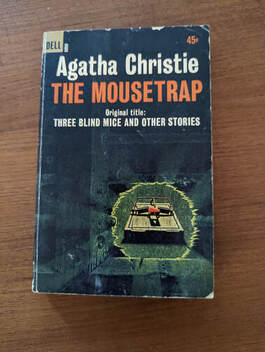 And of course, as old as my copy of the book is, it doesn't compare to how old the play is and has been running. And Ol' Man, Mousetrap, it just keeps rolling along... Back in 1997, I drove down to San Diego to see a pre-Broadway premiere tryout of a new musical called Harmony, which had music by Barry Manilow and a book and lyrics by his longtime writing partner Bruce Sussman. The show told the story of the real-life, German comedy/music group, the Comedian Harmonists, a mixed-religion group in the 1930s who were phenomenally popular internationally, but disbanded with the rise of Hitler. The show was very good, though flawed, being a first-run tryout. I’ve written about it over the years, as it’s come close to getting a Broadway production several times, always falling through. Most notably, I wrote a long piece about it in 2012, remembering the show and not wanting it to full through the cracks into the dustbin of history. As it happened, the next year, much to my surprise – and pleasure -- a revival of the show was to be mounted in Atlanta by the well-regarded Alliance Theatre, moving next to the Center Theatre Group in Los Angeles. Somewhat out of the blue, I got contacted by the show’s PR representative, who’d seen my article and asked if I’d like to interview Manilow and Sussman when the show came to Los Angeles. I did, and we had a long phone interview, of which I posted the resulting article. As a side note, there was a story related to the interview which I didn’t include in the article, but only alluded to. When I was asked later about what that story was, I wrote about it in a separate article -- As I mention in the initial article, the interview came about as the result of a long, detailed appreciation I’d written a year earlier about Harmony -- a piece I did before I had the slightest idea that they were reviving the show. What’s funny is that it turned out Barry Manilow didn’t realize that history when we spoke. Manilow had read that first, glowing article about Harmony -- the PR person for the Alliance Theatre in Atlanta gave him a copy at the time. (I was pretty sure he had seen it, but just to confirm, since it was a year ago, and I wanted to be on solid footing, I asked, "Oh, so you know about the article?" He replied lightheartedly, but bluntly -- "I know everything about this show.") But what he thought and reasonably assumed is that I had written it after I knew Harmony was being done again, thinking that that's what had prompted me. Why else, I’m sure he thought, would someone write such an article about a failed, pre-Broadway tryout 15 years earlier? I corrected him, explaining that, no, I had been completely unaware about the Alliance production, and in a stunned voice he almost cut me off, “Wait, you didn’t know we were doing the show???!!” I answered, “No, I wrote it before I had any idea you were reviving it. I just thought the show was wonderful and wanted to write about it.” And that's when he said -- “Robert, I love you even more than I did before!” (Which would have made a great line in a Barry Manilow-Bruce Sussman song…) Anyway, I kept periodically writing about the show, posting occasional videos of one of the songs he included in his act, a wonderful ballad “Every Single Day,” as well as other videos related to the show. Eventually, in 2022 -- and wonderfully -- the musical got a production in New York. Off-Broadway, yes, but at the highly-regarded National Yiddish Theatre Folksbienne (which only the year before had mounted an acclaimed version of Fiddler on the Roof in Yiddish, directed by Joel Grey). The show was set for only a limited run, but got respectable reviews and was very successful. It also won the Off-Broadway League Award for Outstanding Off-Broadway Musical, and won the Drama Desk Award for Outstanding Book of a Musical (and got two other Drama Desk nominations – for Best Musical and Best Leading Actor in a Musical). And then…thanks to the success of its run – the show, finally, after 26 years, announced it would at least have its Broadway premiere. Which will be this coming Monday, November 13. I’m thrilled. After 26 years yammering about a show, it’s so wonderful to see I wasn’t totally off-based. And I’m thrilled for the writers who stuck with it for over a quarter of a century. I have no idea how it will do. It’s certainly timely – and has been at the various times it’s been mounted, but especially now. It’s a very good show, not “great” but thoughtful, interesting, funny, tragic and with an extremely good, evocative music score. And because of all those years of yammering, writing and interviewing, I feel a certain kindred spirit to the musical. As such, I’ll be posting several items about Harmony, including a CBS Sunday Morning piece on it that recently aired, several of the songs, and starting here today, I thought I’d repost the interview that I did with Barry Manilow and Bruce Sussman in 2014. It includes a link to the original article that brought about the conversation. (What I also didn’t mention in the article at the time is the one challenge I had doing it. I don’t take shorthand. So, it was hell trying to write down accurately what the two of them were saying. Sitting with someone, they can see you’re writing, but over the phone…it’s just conversation. There was one trick I was able to manage – as I would ask my next question, I would stretch it out just a bit with some background and specifics for clarity…but the actual point was to delay their answer until I finished writing down what they’d just said. Writing on the one hand, while also talking at the same time. It was a convoluted effort, but happily it worked out.) Finally in Harmony Again February 24, 2014 A year ago, I wrote here about a wonderful musical I’d seen 16 years earlier in its 1997 world premiere tryout at the La Jolla Playhouse in San Diego. The show, Harmony, was written by Barry Manilow and Bruce Sussman, and took on a challenging, fascinating subject. It concerned the real-life Comedian Harmonistes, a hugely popular close-harmony singing and comedy group of mixed religion in Germany during the 1920s into the 1930s, whose existence was threatened as Nazi rule was taking over the country. Not without flaws, understandable for a first tryout, the musical was nonetheless terrific, with a thoughtful, involving book and lyrics, and rich, evocative music score, and looked to have a big life ahead. But things don’t always happen the way we expect, and Harmony never made it to Broadway, or even had subsequent productions. I didn’t know why, but felt that something that good deserved to be at least be known, so I wrote about it. To my huge surprise, a few months after writing my article, I was contacted by the Alliance Theatre in Atlanta (a Tony Award-winner for Best Regional Theater) to say that they were reviving Harmony. And that it was doing so in conjunction with the highly-regarded Center Theatre Group in Los Angeles. The finally-revived Harmony had a very successful re-opening. The Atlanta Journal-Constitution headlined its review, “Manilow’s Harmony is a glorious work of art.” Critic Wendell Brock wrote that, “In the end, ‘Harmony’ is a nearly flawless work of art that almost manages to cloak the harrowing underside of history in a bubble of elegance, sophistication and wit. At the end of the night, the waltz fades away, but the stars never dim.” I must admit, it was nice to have my memory vindicated, as well as effort to bring attention to something so good which I’d been telling people about to skeptical looks for almost two decades. It really was that good. Next stop for Harmony, then, would be Los Angeles, and the show opens there on March 4. The result of all this is that I had the chance to talk with the show’s creators, Barry Manilow and Bruce Sussman. What interested me most was the show from the perspective of having seen it – its history and artistic construction. And how it may have changed in the intervening years. In short, how in the world it got from there to here in just, at this point now, 17 years. 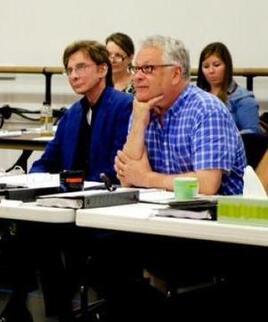 Photo credit: Greg Mooney And that begins with a simple, nagging thought since that day long ago in San Diego. Their never having written a stage musical before, and in the midst of a hugely successful pop music partnership – how in the world did they come across this unlikely story – one inherently filled with singing and comedy, and even romance, but also much harrowing darkness against the bleakest of backdrops, and what was it that cried out that this, with all its challenges, was the one to do? “Bruce saw a documentary on the Comedian Harmonists,” Barry Manilow recalls, “and he was out of his mind about it. We’d been looking for something all these years. And he was so excited about it. He said to me, ‘Blah blah blah blah blah blah blah blah’ (and yes, that’s how Manilow laughingly describes his writing partner’s explosive, bubbling enthusiasm. His amusing point coming across that when you work with someone and they are that enthused about something, the enthusiasm is sometimes all you need.) “And I said, ‘Okay.’” As big a leap as it might seem, to go from pop music into writing for Broadway, it turns out that it really wasn’t. In fact, it was that very interest that initially drew the two together years ago. “When we first met in the Calvin Coolidge administration,” Bruce Sussman jokes about their long-term collaboration, it wasn’t to do pop music at all – “we wanted to write musicals.” “I always wanted to get into writing musicals,” Manilow reiterates. “I thought that that was what I would do, write shows. Conduct musicals, be in the theater. I thought I was a theater writer.” Manilow’s interest didn’t immediately translate with Sussman. It was one thing to appreciate the field, but taking the next step was something else entirely. “I didn’t know about writing this. The first time he asked me, I actually said, ‘No.’ I didn’t know how.” What changed is that in 1970, the musical Company by Stephen Sondheim with a book by George Furth opened. It was different from the type of show Broadway was used to – in its edgy score, pointed and episodic book, and inventive staging. And it galvanized the two writers. “Both of us had seen Company,” Sussman recalls. “Everyone around us saw Company. Everything stopped. We all went, ‘Okay, we have to do this.’” The problem though was one of time – and more surprisingly, of unexpected success. Much as the two now wanted to write a musical, and knew precisely the sort of material they now wanted write, “It takes a lot of time to write a musical,” Manilow relates. “It can take five years. Because my career exploded, though, I just never had the time. I didn’t have time until 1992.” To be clear, not writing a show was never for lack of interest or even opportunity. “ People offered us shows to do,” he continues, “but they never spoke to us. Steven Sondheim told me that if you’re going to write a musical and spend all that time, it has to be something you love, that you want to spend all that time with.” “And nothing interested us enough,” Sussman adds. “So, we just waited. And then this project came along.” Among the things that stood out about seeing Harmony back in San Diego is that the songs did not sound like a “Barry Manilow score.” Most composers have their “sound.” Listen to any show by Rodgers and Hammerstein, even an ethnic period piece like The King and I, and you can nonetheless hear Richard Rodgers in it. Something like Cabaret has the flair of John Kander. But listening to Harmony, if someone asked who you thought composed the music, it’s unlikely that you would single out Barry Manilow. Rather than sounding like a jukebox pop show, the score instead evokes the era, as Manilow put aside his comfort zone for the sake of serving the story and its time. As much as that might seem, though, like a specific artistic decision to have avoided what was familiar and comfortable to him, “I did not consciously set out to not write in my comfort area,” he answers – and then pauses a moment to give the suggestion more thought, and continues with a surprising explanation. “Actually, this is my comfort area. Theater. My comfort area is not writing a pop song. With pop songs all you have to go on is ‘I love you, I miss you.’ That’s the whole blank page. “But this was easy. It’s not easy to write a musical, I don’t mean that, but the songs in a musical have a story they fit in, a context. If you put a chair in front of me, I could write a song about what that chair is. But to write a pop song, and find a new way to say, ‘I love you, I miss you’ – that’s torture.” Though the two men finally had found the story they wanted to tell, and were filled with enthusiasm for it, there still was that whole issue of time. Not about finding the time, but taking the time to get things right. “I did three years of research before I even started to write the show,” Sussman states. “And Barry came back from a tour, and he had all these suitcases full of material, songs from the 1930s he’d collected. We did a great deal of research.” It didn’t occur to them to work any other way, since it’s how they always worked. “If I was to write a song about China,” Manilow says, “I would have studied it and researched it.” What they ended up with was a score for Harmony that stands separate and unique from the Manilow-Sussman collection, and for many years Manilow wouldn’t even perform any of its songs in his concerts. They weren’t “Barry Manilow songs,” they were Harmony. As the years passed, he finally did record an album with several of the songs from both Harmony and his other musical with Sussman, Copacabana. And one song from Harmony at last made it into his concerts, the beautiful, “Every Single Day.” (Although now a part of the concert opus -- though this performance below is from a PBS special on Broadway -- you can tell Manilow’s affection to the song. More than just singing it, he almost throws himself into the number, as if acting it from the show.) Clearly, his concert performance of the song does sound like it belongs in that pop world. Oddly, though, when seeing Harmony back in 1997, even “Every Single Day,” with a totally different, subtle, resonant arrangement, sounded nothing like a song for a Manilow concert. It fit the moment of the show and the character perfectly. So, I was curious how audiences of the musical react when what is now “The Big Hit Song” starts up. “We don’t ‘pop’ up the arrangement of ‘Every Single Day,’ explains Manilow. “In fact, we do some interesting things with it, and at first the audience doesn’t even realize it’s That Song. People are so engrossed in the show, in what’s going on in the scene. And it sneaks up on them before they recognize it. By the time the song is over, though, audiences have been going wild.” Which brings us to today. And how these two writers got their show back on stage after a mere 17 years. And how they’ve revisited it themselves. My recollection from long ago was that the first act of that original production was very strong and tight and rich with story, extremely involving, while the second act, though quite good, was trying to find focus. I was curious if that had been their perception, as well. “That’s interesting what you say about focus,” Sussman laughs. “The first act was an hour and 45 minutes. But even running that long, we never got complaints about length. None. However, we always felt it could be stream-lined, and now it’s only an hour and four minutes.” “In that first production,” adds Manilow, “we threw everything up on stage. We were just trying to find out what worked. We didn’t even think anyone would come down to San Diego to see the show! We just wanted to get it onstage, and work on it.” In the intervening years, though, they two have been able to step back and look at the production with a dispassionate eye, and have indeed kept working on the show. From what they said, it seems that most of the effort has been with the second act – although “We did add major new element in the last scene of the first act,” Sussman explains. “It’s a theatrical device that’s thrilling. In the new second act, though, three songs have been removed, two new songs were added, and we even removed one character.” Because the show is so centered on this group of six men and the powerful, dramatic turns their lives go through, they take up the bulk of the stage time. However, there are still two wonderful roles for women, who the men get involved with. (When I saw it in San Diego, one of those roles was played by Rebecca Luker, then at the start of her already-burgeoning Broadway career. She’s since been nominated for three Tony Awards. Interestingly, also in the cast was Danny Burstein, and the two subsequently married.) I was curious if the limitation of female roles was ever a concern for the writers, to try and expand those stories – or did they feel more compelled to stick to the core story and however the women developed from it.) “The women have been better developed than in the original production,” Sussman acknowledges but then laughs self-effacingly. “You should have seen the original script, though. There were eight women in it. You needed a scorecard to keep track! I even put one of the character’s mother in it. I felt he needed a female relationship to his story.” Needless-to-say, all that got dropped. One of the hurdles that was most intriguing about staging the show is that the real-life Comedian Harmonists were utterly remarkable in their vocal gymnastics. (A recent German film on the group uses recordings of the real group.) So, it seemed like that would be a huge challenge to mounting this musical. The actual Harmonists trained for years to be as pitch-perfect and intricate as they were, not just in their singing, but also comic timing. So, how do you find performers who – while not duplicating the artistry of what the originals did – would be able to sing close harmony so well and have such impeccable stagecraft that audiences would believe and accept that these six men on stage are truly that otherworldly good? “This is a very complicated score for actors to do,” Manilow admits. “On the other hand, it might be a dream come true for them. It’s what they studied their whole lives – singing, dancing, acting, doing harmony, timing, everything -- and they get to do all of it in the show. But you do have to be a real actor-musician. They’re not just singing melody, they’re all singing harmony.” All of which begs the overriding question: how in the world did Manilow and Sussman get here? After 17 years wandering in the desert, what happened?? Not only “what happened” in what had been blocking them – but how were they able to get over that hump that had been in their way for almost two decades. It’s a question that the two men have lived with for a long time. “Every Broadway musical has a big mountain to climb,” Manilow says in a voice dripping with experience. “The issue was never the show. People always loved the show. The problems were always investors, producers, financiers, and we’d be stuck for three years. I don’t want to get into specifics, but when you sign a contract with a producer, it’s for three years. There’s nothing you can do. We spent years going from producer to producer, and it just took so much time.” Eventually, the two men decided to regroup and simply “put the show in the drawer” as Sussman says, for the time being. To not press the issue, but wait until they could get it right. Then last year, taking matters into their own hands, they did something vibrantly uncommon. Without lawyers involved, without agents, without anyone else involved, they themselves alone picked up the phone and called the Alliance Theatre in Atlanta, which they were aware had a very good reputation. Yet it’s far more odd than that. This wasn’t a case of just calling the Alliance Theatre on their own, cutting through all the red tape and going straight to the top through one of their many connections, but rather – “We called the main number of the theatre,” Sussman laughs. “We just called the lobby.” They didn’t know anyone at the Alliance. They just thought it would be a good theatre. Needless-to-say, the operator at the front desk was a bit surprised by the call. (One can only imagine the conversation, “I have Barry Manilow on Line 2…No, really.”) But she eventually was convinced who it was she was talking with and connected the two men with Susan Booth, the artistic director who heads up the theatre. It turns out that the reputation of the show over the years preceded the call, and Ms. Booth was not only aware of the musical, but hopeful. “The first thing she said was, ‘Please tell me it’s about Harmony.’” Booth asked for some time to think about the show, needing to decide what she wanted to do with it, and how the musical might fit in with the Alliance. Given that Manilow and Sussman had waited almost 17 years at that point, waiting a while longer wasn’t a problem. What they didn’t expect was how incredibly short they would have to wait. “One hour later she called back to say they wanted to do it,” Sussman says, his voice still not quite believing it – or quite believing what came next. “And she also gave us a start date.” After roadblocks of 17 years, just picking up the phone and calling the front desk did the trick. In a single hour they not only had an acceptance, but a green light to go ahead. Yet success breeds success, because things only got better. “Six weeks later,” Manilow adds, “we then got a call from the Ahmanson. They’d heard about us working with Alliance, and they wanted to get involved, too.” 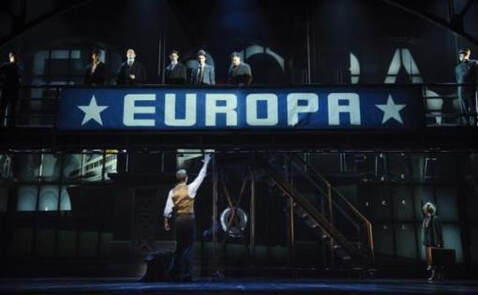 Photo credit: Greg Mooney As difficult and long as the journey has been with Harmony, Bruce Sussman makes clear that they even consider themselves lucky. “The truth is that if it wasn’t for the spotlight of Barry, we never would have gotten this far. The theater is full of people who struggle for years to get their shows on. We know a dozen people with shows who have been trying this long.” There’s absolutely no scintilla of bitterness or regret or even disappointment in their voices as they talk about the two-decade gestation of their show, and getting it staged at the Alliance, and now the Ahmanson. Only palpable enthusiasm and excitement. “Even though it’s been a rough road, it was something we believed in,” Manilow makes very clear. “That’s why we’ve stuck with it for all these years. We believe in this show. We love it.” And that’s why they went about it now they way they have. Not a huge commercial house on Broadway, but regional theater. “Regional theater is the only way to do it the way you want it done,” he continues, his exuberance and admiration building. “Neither Alliance or the Ahmanson have ever asked us about profits or anything like that. That would never happen in the commercial theater. But we’ve had the chance to do the show the way we want it, to get it right. We’re doing the Harmony we wanted to be.” But what about that Harmony and what they’ve always envisioned? Surely there’s a larger goal ahead. You don’t stick with something this long without having that great end in sight – do you?? Other regional theaters, touring, and…perhaps Broadway? I’d read the two men discount having such thoughts, how that wasn’t in their minds. I admit to being skeptical – how could you not be thinking about what’s next?! – but hearing Manilow enthuse about what they have, right now – and the love of the work they’re doing, right now – he actually makes it all makes sense. It is so clear how much he and Sussman dearly love this show, the show that they’ve worked on for two decades, and are just bursting with pride for what it is. Getting on stage in two such prestigious venues. Not for what it might be, possibly, maybe, one day, perhaps. “If there’s a future to it, great,” Barry Manilow says emphatically. “If people see it and want to take it further, great. But we are not thinking about the future. We are only thinking about this show and getting it right. We’ve had the best time with it. It’s been a thrilling experience. And if it doesn’t get any further, that’s fine. We’ve just had the best time.” Harmony has its second life, re-opening at the Ahmanson Theatre in Los Angeles on March 4. What happens next is in the hands of others. What happens now is in good and appreciative hands. It's Halloween, so we turn these pages over to the day. Those waiting for the next edition of the Elisberg International Film Festival will just have to wait an extra day. Some things have priority. I told this story six years ago (almost to the day, but definitely to the occasion), but it bears repeating. My favorite Halloween memory came about 20 years ago. And it involved a Staples office supply store. No, really. In the late afternoon, I parked in the lot of my local West L.A. Staples and headed towards the building. And coming outside at that moment was Ray Bradbury. 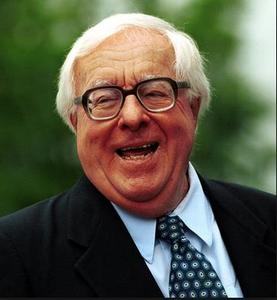 Now, mind you, that alone would have been good enough. I've always loved Ray Bradbury's writing, and the first book of his I'd read was his classic Something Wicked This Way Comes, which centers around Halloween. But then, so did many of his works. He wrote a collection of stories, The October Country. One of his creepy stories is "The October Game". He wrote a short novel, The Halloween Tree. And much more. Side note: years after I read the book, Disney Studios made a movie out of Something Wicked This Way Comes. A friend at the studio got me a copy of the screenplay and poster, both personally signed to me by Ray Bradbury. Which I still have. So, the author, book, and the connection to Halloween has long been strong with me. 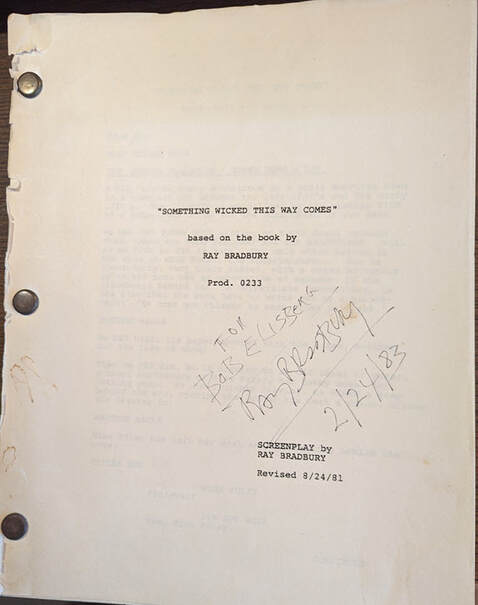 And then there was Ray Bradbury. On Halloween. I tend not to go up to celebrities. And Ray Bradbury was clearly not in the best of health, helped by a caregiver. But...this was Ray Bradbury. And it was Halloween, for goodness sake. You don't ignore that and expect to have any self-respect. It would almost like avoiding Santa on Christmas. Sure, Ray Bradbury busy because he's the patron saint of the holiday, but he more than almost anyone in the world is celebrating the day to its fullest. And wants the day celebrated to the fullest. So, I walked over, simply said how much I enjoyed his writing and expected to leave it at that. But he was charming, and engaged me in conversation, helped in part by him finding out that I grew up near where he did, in Waukegan, Illinois. (Glencoe, where I'm from, is about 25 miles directly south.) I don't recall a great many specifics about the conversation, though I do remember his saying how Halloween was his favorite holiday. (Gee, no kidding!) Which is why it came as a thrill -- and is my favorite Halloween memory -- when, as we parted, Ray Bradbury wished me, "Happy Halloween." 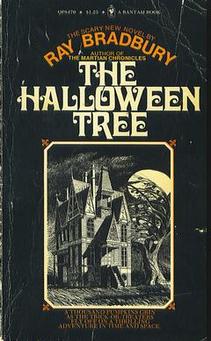 |


Elisberg Industries gets a commission if you click here before shopping on Amazon.

AuthorRobert J. Elisberg is a political commentator, screenwriter, novelist, tech writer and also some other things that I just tend to keep forgetting.    

Feedspot Badge of Honor
Categories
All
|
 RSS Feed