Movie Magic: Now You See It, Now You Don't
- Sep 29, 2025
- 6 min read
Over the past few days, Trump has added several large, new tariffs -- including ones on big trucks, upholstered furniture (yes, really), cabinetry (yes, really) and drugs. Because...oh, I don't know, to make kitchens great again, or something.
And then yesterday, Trump added one more. On movies made in foreign countries. I'll let him explain, because I don't have the heart to speak for him on this one. (Note: The yellow highlighting was put in by them third-party person who posted this, not Trump.)
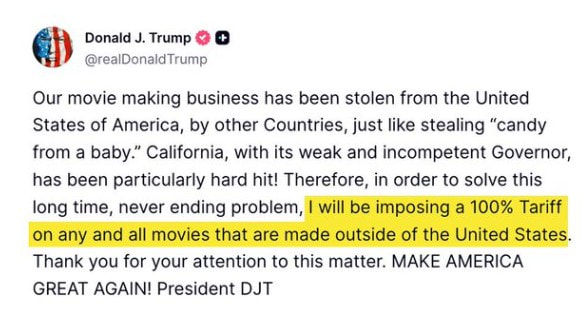
Trump hinted at this months ago -- and him actually finally getting around to doing it is not less ludicrous and ignorant about moviemaking now than it was then.
And it's very ludicrous and incredibly ignorant about moviemaking -- and on so many levels. And just to explain that this is not hyperbole, yesterday I got calls from two friends who are filmmakers, and both asked, "Can you explain what's the point of these tariffs?? Because I don't understand." To which I answered, no, because there is no point to them. "I ask," they each said, "because that's not Hollywood works." I know, I replied, that's what my article for tomorrow is is about. And then they kept describing all the things that don't make sense to them. To which I replied -- again -- that's what's in my article.
For a very basic starting point on what's so ludicrous and ignorant about how moviemaking works in this tariff, from what Trump says here -- because he says very clearly that this is about "all movies that are made outside the United States" -- the tariffs will include foreign movies made by foreign filmmakers shot overseas in their foreign home countries that aren't stealing anything from America. Nothing, zero. And that makes absolutely no sense. (Furthermore, if that's just a slip of the tongue and he doesn't mean those foreign-made movies, then it's even more loony since Trump is then giving an advantage to foreign filmmakers over Americans.)
But back to the very basic starting point, here's just one recent example why this is ludicrous and ignorant. There are, oh..., a great many thousands others.
Two weeks ago, I watched the movie Hytti Nro 6 (Compartment No. 6), a production from Finland that won the Cannes Grand Prix award. The story of film is “A Finnish student and an uncouth miner slowly forge a hesitant connection when they throw together in cramped train quarters on a journey across Russia.”
I can assure you with almost near-certainty that if Finland filmmakers hadn’t make the movie, no one in the Hollywood, or anywhere in the United States would have. In fact, it’s possible that if you had suggested it, you might have been laughed out of the studio executive’s office, after which he would have told his secretary, “If you let that person back in my office ever again, you’re fired.” Zero American jobs were lost because of Compartment No. 6. Going further, I suspect every year at the Oscars, when the Best International Film category comes up, tens of millions of Americans watching the broadcast are thinking, “Why do they even have this category?? I’ve never heard of these movies. And I will never watch them. I hate foreign films. It’s people sitting around in berets smoking cigarettes and pausing in silence for minutes on end." And these are the best of the foreign-language films. (And no, that’s not what foreign films are. The best of them especially are often remarkable. But still Hollywood wouldn’t make most of them.) Occasionally, Hollywood does remake a great foreign film – though when they do, it’s make here in the Good Old U.S. of A, with Good Ol' Amurican actors and crews.
And as I noted, there are mountains of other examples.
For that matter, if a U.S.-financed movie is shot overseas, yes, the jobs on that film will mostly be foreign -- but the revenue made will go to the U.S. company, on which it will pay taxes. Moreover, many, if not most, movies today have co-production deals with foreign companies for the overseas market. Those (even though filmed in the U.S.) are not "made" outside of the U.S. -- but some of the revenue goes outside the country.
But this isn’t even the main stupidity and ignorance of Trump's 100% tariff.
The U.S. film and television industry -- from global box office, licensing, home video, and streaming services -- is one of the biggest international revenue industries in the United States. From international box office alone, its revenues are around $34 billion. It’s actually doing really well. No one is stealing anything from Hollywood. The concept is laughable. If anything, it’s long been the very opposite.
But further, if a U.S. studio has a story about romance in Paris or exploring 19th century Brazil, or ancient Roman ruins, where does Trump expect it to be made? Pacoima? Also, yes, California has lost some productions, but they have gone to other U.S. states offering major tax concessions, not to Europe! They're still in the United States! (In fact, within the past month, California just passed a state law to provide tax breaks in order to combat what’s known as “runaway productions”. That’s what was needed – not tariffs, for higher taxes on American consumers.
And even more, the most ignorant thing about putting tariffs on movies made overseas, is that it’s far more likely to devastate movie theaters in the U.S. than studios. Studios don’t rely on U.S. movie theaters – and that was true long before COVID upended how people watch movies with streaming. In fact, studios don’t even necessarily rely on the U.S. for revenue – as hugely important as the U.S., of course, is. But the world market is 2-3 times bigger than the U.S. market.
Oppenheimer made a massive $330 million in the U.S. Overseas, it made $645 million.
Avator grossed an ungodly $785 million in the U.S. Internationally, it made $2.1 billion.
(Its 2022 sequel made $684 in the U.S. Around the rest of the world, it took in $1.6 billion.
Barbie made $636 million in the U.S. Overseas , it made $811 million.
You get the point. Although, no, you probably don’t. Because most people in Hollywood don’t really get it. Here’s what I mean.
When they made Bridget Jones Diary, it grossed $71 million in the U.S. But the sequel, Bridget Jones: Edge of Reason, was considered a big flop by Hollywood experts, only making a paltry $40 million here. But if you’re wondering why they’ve made two other Bridget Jones movies – that’s because that Edge of Reason sequel gross $224 million internationally!!
Or better still – the sequel to the hit comedy Johnny English with Rowan Atkinson was called Johnny English Reborn. And it only took in a threadbare $8 million in U.S. It wasn’t just considered a flop by Hollywood so-called experts, but a massive disaster. However, around the rest of the world, it made – are you ready? -- $151 million!!! That’s why there was a third Johny English film. (Alas, it made a microscopic $4 million in the U.S. Although – and yes, you may have figured this was coming if you’ve figured the point out by now – it made an additional $154 million overseas.
So, yes, Hollywood loves the U.S. market. It's huge. Important. Very important. But as a core, overriding, foundational principle, no, it doesn’t need it. The world market is 2-3 times bigger, sometimes much more. That's something most people, including Trump, haven’t grasped. It's U.S. movie theaters who need it.
Though, putting aside how ignorant this is on moviemaking -- I'm not sure what Trump is putting a tariff on. When a film is made overseas and the footage is "brought" into the U.S., does Trump think that product – the raw stock footage, or the digital content -- is then “sold” to Americans??? Of course it isn’t. A copy is shown in theaters for the public to watch, or its streamed into homes. They don’t even make DVDs to sell anymore.
For that matter, for all I know, films could be streamed from Europe without even going through Customs.
But there’s Trump, trying to pretend he’s an expert on everything, this time on Hollywood and moviemaking. Not beginning to understand it, not understanding how really well it’s doing for the United States and much revenue it brings into the country. Not understanding what “runaway productions” really are – nor understanding that taxes were just lowered to address the problem.
I was asked by someone what in the world the point was to put tariffs on movies made overseas.
There is none. Because this action is so ludicrous that it borders on insane. The closest I could figure is that it’s Trump’s dementia. His existing tariffs have been horrible for the economy already, and haven’t even seriously kicked in yet. And then he’s started to pour out more tariffs – and then added even more, on big trucks, upholstered furniture, kitchen cabinetry, and drugs. And now…movies made overseas???! Tariffs are all his dementia obsessed mind can focus on. So, it keeps repeating, and we get more and more and more. And it will get worse because dementia is degenerative. And there’s no one he’s put around him who is competent to help him – if they even wanted to, at risk of losing their jobs.
And this is not just about Trump. It’s about the MAGOPs in Congress who enable and support him. And are unwilling to vote to stop Trump’s declare “emergency” and take back their Constitutionally mandated authority as the only branch of government who can create tariffs.
Comments