The Times of Larry David
Larry David wrote a guest op-ed essay for the New York Times yesterday. It's creepily funny, pointed and wonderful. While I want to post the whole thing here, I'm a bit torn: I have a subscription to the paper and am allowed a free link to share -- and could share the link everywhere on social media for millions of people to click on, and I...er, don't have anywhere near that many people who read these pages -- but that's still different from copy/pasting the whole article here. With a link, it actually takes you to the newspaper itself, albeit with very limited access -- where you can read User Comments, as well as (in this case) a commentary about the op-ed by Patrick Healy, the Deputy Opinions Editor.
What I've decided on is to post about half the article, which will give a full sense of what the piece is about -- and then embed the link for those who want to read the rest of the op-ed.
I'm also going to quote from Mr. Healy's comments.
The point of Larry David's piece is an imagined dinner he had with Hitler in 1939. It's a scathing piece directed at business leaders who spoke out against Trump during President Biden's term in office and then have acquiesced to Trump. With also what seems clear to be a dig at Bill Maher who praised how human and personable Trump was after being invited to a dinner with him.
First though, this below is, in part, what Patrick Healy, the paper's Deputy Opinion Editor wrote. The whole thing is thoughtful and interesting (and you can read it all if you end up clicking on the link to Larry David's op-ed, since you can get to it on that page). But what I found most interesting is that the New York Times felt a need to print what is, in essence, a disclaimer, saying "Oh, no, we're not equating Trump to Hitler. Nor is Larry David." And no, Larry David is not equating Hitler to Trump. But if I was making a guess, it would be that David would not go out of his way to tell you that. --
Last Wednesday night I received an email out of the blue from Larry David, the comedian and creator of “Curb Your Enthusiasm,” saying that he had a guest essay submission. I opened the document and read the first line: “Imagine my surprise when in the spring of 1939 a letter arrived at my house inviting me to dinner at the Old Chancellery with the world’s most reviled man, Adolf Hitler.”“OK,” I thought. “This is different.”Times Opinion has a high bar for satire — our mission is geared toward idea-driven, fact-based arguments — and we have a really, really high bar for commenting on today’s world by invoking Hitler. As a general rule, we seek to avoid Nazi references unless that is the literal subject matter; callbacks to history can be offensive, imprecise or in terrible taste when you are leveraging genocidal dictators to make a point....I also understood Larry’s intent in writing this piece. We had spoken about American politics and how some on the left and in the center think it’s important to talk and engage with President Trump. Like many people, Larry listened to Bill Maher talk about his recent dinner with Trump; Bill, a comedian Larry respects, said in a monologue on his Max show that he found the president to be “gracious and measured” compared with the man who attacks him on Truth Social. Larry’s piece is not equating Trump with Hitler. It is about seeing someone for who they really are and not losing sight of that.
And here then is the opening of Larry David's opinion piece.

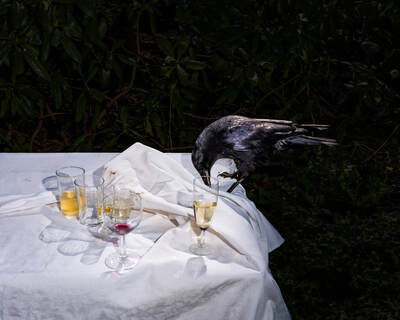
(Mr. David is a comedian and writer who created “Curb Your Enthusiasm” and was a co-creator of “Seinfeld.”)
Imagine my surprise when in the spring of 1939 a letter arrived at my house inviting me to dinner at the Old Chancellery with the world’s most reviled man, Adolf Hitler. I had been a vocal critic of his on the radio from the beginning, pretty much predicting everything he was going to do on the road to dictatorship. No one I knew encouraged me to go. “He’s Hitler. He’s a monster.” But eventually I concluded that hate gets us nowhere. I knew I couldn’t change his views, but we need to talk to the other side — even if it has invaded and annexed other countries and committed unspeakable crimes against humanity.
Two weeks later, I found myself on the front steps of the Old Chancellery and was led into an opulent living room, where a few of the Führer’s most vocal supporters had gathered: Himmler, Göring, Leni Riefenstahl and the Duke of Windsor, formerly King Edward VIII. We talked about some of the beautiful art on the walls that had been taken from the homes of Jews. But our conversation ended abruptly when we heard loud footsteps coming down the hallway. Everyone stiffened as Hitler entered the room.
He was wearing a tan suit with a swastika armband and gave me an enthusiastic greeting that caught me off guard. Frankly, it was a warmer greeting than I normally get from my parents, and it was accompanied by a slap on my back. I found the whole thing quite disarming. I joked that I was surprised to see him in a tan suit because if he wore that out, it would be perceived as un-Führer-like. That amused him to no end, and I realized I’d never seen him laugh before. Suddenly he seemed so human. Here I was, prepared to meet Hitler, the one I’d seen and heard — the public Hitler. But this private Hitler was a completely different animal. And oddly enough, this one seemed more authentic, like this was the real Hitler. The whole thing had my head spinning.
He said he was starving and led us into the dining room, where he gestured for me to sit next to him. Göring immediately grabbed a slice of pumpernickel, whereupon Hitler turned to me, gave me an eye roll, then whispered, “Watch. He’ll be done with his entire meal before you’ve taken two bites.” That one really got me.
You can read the full article here, (along with Patrick Healy's comment).
Comments