Bobbing for Medals: 2024 Edition
We spend most of the day watching the Olympics, so you don’t have to.
This will be long (but then most are, I know, with a bunch of videos) -- but be sure to make it to the very end, even if it means skimming, because there's a classic video if you've never seen it, and still a joy if you have because it's likely been a long time. Though even if recently, it remains worth seeing again.
Wonderful to see Team USA’s Suni Lee get a Bronze medal in the uneven bars. Given that she had to come back from two very serious kidney diseases, it’s remarkable. And nice to see Kaylia Nemour of Algeria finally get a Gold in the floor exercise, after finishing behind Simone Biles in everything before. And a gracious acknowledgement to her from Silver and Bronze medalists Biles and Jordan Chiles, both of Team USA.
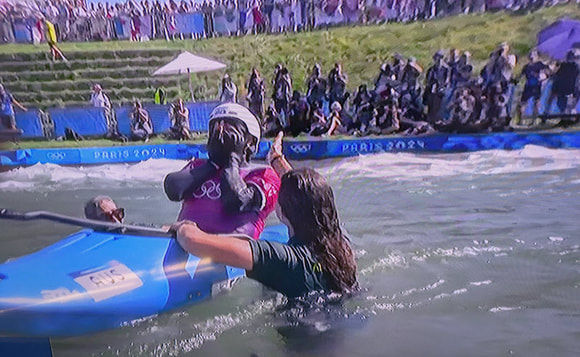
They had the finals of the new Olympic sport, Kayak Cross, which as I said the other day is like a combination of canoeing and bumper cars, with the “Benny Hill” music playing over it. And once again in kayak, the Gold medal went to Australia’s Fox. But – no, not the legend Jessica Fox, but her younger sister Noemie, in her fist Olympics! She was overwhelmed when she won. So much so that she threw her paddle in the water with an aggressive slam – but then hilariously realized, oh, wait, I’ll need my paddle to get back to shore, and quickly grabbed it again. And so thrilled was her big sister, that double-Gold winner Jessica leaped into water and swam to her. But notable too in the screenshot I took is that you’ll see an older woman with sunglasses on the other side of their boat – that’s their mother…who is a former Olympian herself in the sport!
O joy, the Velodrome is open for business! I like cycling races, but I especially like them when they take place in a Velodrome. What I like about Velodromes is that they're unlikely any other indoor stadium. They're not a stadium that you can swap out the floor and make multi-purpose, they're for cycling only. And they have a look that is both futuristic and old-timey, a tough combination to pull off. Further, the races and rules are just a touch odd, but fascinating -- and I can't even tell you exactly what they are, but I like team events when, all of a sudden, one of a team's riders glides up the side of the Velodrome, and then fades off, letting the others continue on alone -- only to magically reappear and slide back into an open spot. But also, I just like the word "Velodrome." Well, they started the Velodrome events today, the women team sprints, and Great Britain won the Gold, beating out New Zealand for the Silver.
As I’ve noted previously, it’s one thing for IOC officials to say the Seine was safe of e coli bacteria for Olympic swimmers, it’s another to say it’s safe. And Belgium has now dropped out of the mixed triathlon event – and Switzerland has changed one of its athletes – after an athlete from each country became ill after having competed in the earlier men and women triathlons. To be clear, those countries have said there is no direct evidence yet that the illnesses were caused by swimming in the Seine – and organizers insist that water tests do show the water quality was at a level considered “very good” by World Triathlon standards. The mixed relay triathlon went on as scheduled, as the two ruling organizations for the sport have said that the water quality has improved the past day. The relay event was sort of interesting – not as grueling as a standard triathlon but a good addition. Two men and two women for a team, with each part of the race much shorter. Once an athlete completes his or her swim-bicycle-run, they tap their teammate to continue. How close and exciting were the results? Although there was a minute gap between third and fourth place, those three medal spots were separated by only one second! And more to the point, I went to sleep having seen the Americans do a great job and finish third (it ended at 12:30 in the morning) – but when I later woke up and turned on the TV, the judges had switch that result and gave the Silver medal to the U.S. team!
Early heats of discus, shotput and hammer throw have been going on. I like those events and enjoy watching them – though I find something odd about them. And it’s that they’re all basically the same. Throwing a heavy object as far as you can. Throwing a dish, a lead ball, and a lead ball on a chain. (You could also perhaps include the javelin, throwing a stick.) I understand that the technique for each is different. And I also understand that they’re each legitimate disciplines. It’s just that it’s so odd to me because they are essentially the same. Also odd is how their distances are determined – a judge stands far away, far enough so they don’t risk getting whacked by a flying heavy object…and then the person runs over and marks as close as possible to a spot where he thinks and can estimate where the object landed. Obviously, the judge shouldn’t risk getting clobbered. And there are other events where a similar “guess” determination is made (like the long jump and triple jump). And while those distances are also less exact than ideal, at least in those others the judge is extremely close to the marking point to see where it should be – and to get there quickly to remember the spot and measure it. Maybe at some point in the future, they’ll have a way to determine such distances electronically, but for now it’s very manual and somewhat random. Though for all the flaws of human error with such much at Olympic stake (and stake in every track & field competition), there’s something endearing about it.
The women’s high jump was completed on Sunday, won by Ukrainian Yaroslava Mahuchikh. Whenever I watch the high jump these days, I can’t help but flash back to one of my favorite Olympic moments – when Dick Fosbury changed the sport at the Olympics in 1968 at Mexico City. I’ve written about this before, but it always bears repeating. Bear with me, but we’re going to take a detour into Olympic history for a bit – my version of an Olympic Flashback Moment -- because I think it’s a great story. Consider, after all, when we watch the high jump, we see the athletes leap high, twist their body and throw their back over the bar. But for most of Olympic history, high jumpers threw their body over the bar with their chest, using a “scissors kick,” straddling it. Jumping forward -- not...backwards.
Yet now they jump backwards. Upside-down. It's called the Fosbury Flop because of the man who invented it and was the first to risk the ridicule of the track & field world, Dick Fosbury. He developed it in high school, because "I was probably the worst in the state of Oregon" and an injury was caused by landing on wood chips that some schools still used in the pit. Few around the rest of the world knew about Fosbury and his flop. But I remember first seeing it at the U.S. track & field trials before the 1968 Games. And as a little kid, I was bowled over by how fun and goofy it looked – and at how successful Dick Fosbury was. So, I couldn’t wait for Mexico City – I knew that almost no one in the world had a clue what they were in for.
That sound of the Olympic crowd’s reaction is still a visceral memory to me. I watched in anticipation, knowing what was coming, knowing the people in the stands didn’t know and then Dick Fosbury jumping, twisting and for the first time ever in the Olympics…going over backwards – and the people watching this in the stadium ROARED. With each successive jump, more people in the stadium caught on to check out the high jump pit, and the ROARS grew. And it became cheering by the end as it seemed like everyone was watching. And going wild as this totally unknown Dick Fosbury kept flopping over the bar until…he won the Gold medal. And set a new Olympic and United States record at 7 ft-4¼ inches!
It changed the event. Today, it is the standard. Every Olympic high jump champion after 1972 has won the Gold medal using the Fosbury Flop. Every high jumper today uses the Fosbury Flop. Here's a video that tells the story very well. It leaves out the injury and – unfortunately – The Sound. But do your best to imagine it, the stunned, bewildered, overjoyed, laughing, cheering, roaring sound. Growing with each jump.
As a bonus, I've tracked down a video of Dick Fosbury and other competitors jumping at the 1968 Olympics. You don't get the full experience, but importantly it has sound and also shows the world of what high jumping was like in 1968 with everyone using the scissors kick – and then there’s Dick Fosbury who comes in past the 2:00 marks. And happily, because there is sound, you hear the roars.
And just because the guy deserves an encore, this is a very nice 2-minute feature on Dick Fosbury with the good fellow looking back on how he developed the Fosbury Flop and self-effacingly talking about that day in Mexico in 1968.
Synchronized swimming (or Synch ‘R Swim” as I call it) began today. Though they’ve changed the name to “Artistic Swimming,” likely it would seem because the original name has a tarnished reputation. Though from my perspective, “Artistic Swimming” is far worse. That they call it “artistic” shines a light on the problem to me – it’s artistic, pretty…but it’s not a sport, any more than artistic ballet is. Or artistic acting is. Synch ‘R Swim is very difficult, physical and pretty. So, is ballroom dancing – that has competitions, but it’s an artistic competition, not a sport. (I cringe that one day it might be in the Olympics. But not yet.) Same with ballet. I will not be watching Synch ‘R Swim during the Olympics, so there won’t be any reports on it here. It’s one of what once were two events I feel that way about – the other being Rhythmic Gymnastics. O Good Lord, waving ribbons and throwing a ball in the air. Spare us. But now there’s a new event to the Olympics which I can add to my, “No, that is not a sport, no matter how physical, difficult and pretty, and it’s stupid that it’s in the Olympics” list – break dancing. Yes, really. Which to make it seem better, like it’s really a sport, they call “Breaking.” Sorry, no, it’s not an sport, and not an Olympic sport. Just like “Artistic Synch ‘R Swimming.”
Which allows us to joyously bring up this. What I hinted about at the very beginning. Some of you may already be ahead of me. It’s the legendary 4-minute film from Saturday Night Live film made in 1984. It’s a mock documentary with Harry Shearer and Martin Short as brothers who want to be the first male synchronized swimmers, working with a choreographer played by Christopher Guest (a character he would use later in the movie Waiting for Guffman). The film is superb, a joy and devastatingly scathing. In fact, years later, when Synchronized Swimming was finally about to be in the Olympics I read an article in the Los Angeles Times about its journey getting there. And they interviewed the movie star Esther Williams – who had made Busby Berkeley swimming extravaganzas – who for years had championed getting the artistic activity into the Olympics. And she said that it was this very SNL sketch that was so devastating in its satire that she felt it single-handedly kept Synchronized Swimming out of the Olympics for a decade! Making me love the film all the more. Here it is –
Let the Games continue…
Comments